Shi Zhengli, a top Chinese virologist, departed the Singapore bat conference in December 2019. She traveled back home to a calm Wuhan. By December 2019, SARS2 had spread quietly to northern Italy, France, Norway, and America, but most of the world only noticed Wuhan in February 2020.
Outside Wuhan, Western virologists were familiar with Shi. In late 2019, she traveled to Singapore, Sweden, Africa, and Paris. Shi organized a conference at the Wuhan Institute of Virology, where she oversees a BSL2 coronavirus lab. During this meeting, Shi presented on MERS, attracting several Western virologists who flew in to participate.
Wuhan’s appeal to Western virologists lies in its distance from Beijing, 700 miles away. A Chinese proverb encapsulates this distance: “The mountains are high, and the emperor is far away.” In February 2020, Cliff Lane from NIAID, a close colleague of Fauci, visited Beijing and reported on the tense atmosphere. He noted, “Nerves in China are very raw. High-level officials in Wuhan have been fired. We are in the middle of a political earthquake, and there will be enormous scrutiny of our work. Extraordinary measures, at great cost, have been put in place in China.”
According to The New York Times, Shi Zhengli is not affiliated with the Communist Party and is categorized as “nonpartisan,” a rarity for someone of her status as a state employee. The US State Department vetted Shi in May 2019 because of her role as a contractor for NIAID under the renewed EcoHealth grant. Peter Daszak remarked, “Shi’s also extremely indiscreet about how she speaks. She tells you things and expresses opinions that would get people into trouble in China.”
Most Chinese Communist Party-owned labs are in Beijing, while military labs are near the North Korean border. However, in the heart of the enormous country, Wuhan stands out with its concentration of civilian labs in a bustling college town. The pipeline of postdoctoral researchers from nearby universities has fueled cheap scientific inquiry, making Wuhan a prominent research hub near the bat caves where coronaviruses exist. Wuhan had become known as the world’s live Chinese horseshoe bat capital. Traveling to remote bat caves, capturing wild bats, and maintaining them in local labs for Western virology experiments was straightforward.
Shi Zhengli began her career as a research assistant at the Wuhan Institute of Virology (WIV) in 1990, advancing through the ranks. Daszak bragged in his NIAID grant, “Shi and Daszak have collaborated since 2002, running joint conferences, co-authoring papers, and shipping samples into and out of China.” Wuhan was also the only place on the planet with a BSL4 high-security lab with access to wild-caught Chinese horseshoe bats. These bats were the known reservoir host for SARS-like viruses, so they intrigued the rich biodefense world.
A NIAID employee, Ping Chen, based at the US Embassy in Beijing, visited Shi Zhengli multiple times. Her NIAID boss in the US referred to Chen as the “eyes and ears on the ground to support the scientific collaborations.” Chen’s visit reports detailed a strict Beijing biosecurity policy with Wuhan workarounds. In a 2016 email, she referenced live bats in WIV labs, noting, “We are talking about close animal-human contact in a densely populated city.” Among several labs in Wuhan, only Shi’s and Dani’s were focused on coronaviruses and bats.
In a 2017 email, Chen observed, “It is clear to me, by talking to the Wuhan BSL4 technicians, that there is certainly a need for training support since it’s the first one in China, and they have to learn from others.” The “others” likely referred to Dani, as Shi was occupied with other responsibilities.
Shi attended the opening ceremony for the new Wuhan BSL2 lab on December 12, 2019. The China CDC had built this lab on the north side of the Yangtze River, within 1,000 feet of the infamous Wuhan wet market. This was the only lab located north of the massive river that divides this modern metropolis of 8 million people. A scientist in the new BSL2 lab even uploaded a video in December 2019 showing him collecting bat samples from nearby bat caves.
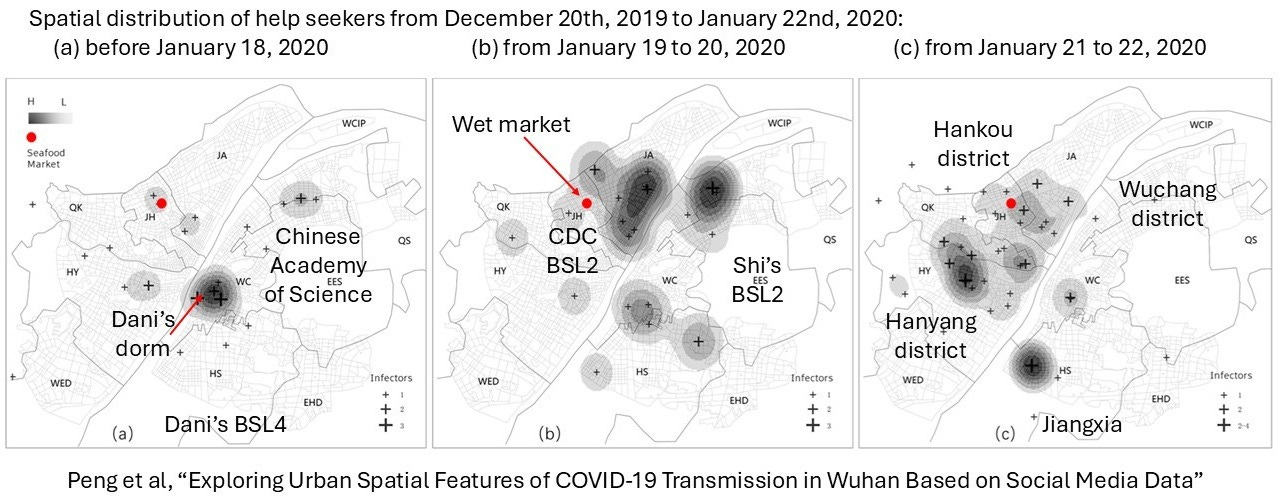
The opening ceremony for the new BSL2 lab in Wuhan may have been the second superspreader event of 2019. In late December, sick patients filled Wuhan hospitals on the north side of the Yangtze River. However, in early December, Weibo (China’s Twitter) found SARS2 spreading on the river’s south side. Eleven of the twelve labs in Wuhan are south of the river, including the BSL4.
On December 30, 2019, Shi traveled to Shanghai for a conference. While she never specified the details, it is known that the University of North Carolina (UNC) sponsored a conference in Shanghai around that time. Shanghai is also home to East China Normal University, Linfa Wang’s alma mater, which functions as a NIAID subcontractor, shipping coronavirus samples to “US partners.” Additionally, NIAID sponsors a lab on the Fudan University campus in Shanghai.
On the same day, December 30, 2019, the Wuhan Institute of Virology (WIV) received the first samples from Wuhan pneumonia patients and isolated the virus. The CIA disclosed that “China’s officials probably did not have foreknowledge that SARS2 existed before WIV researchers isolated it” on December 30. It is essential to distinguish between the relative ease of isolating a genome already present in humans, as done by WIV, and the much more complex task of creating a new coronavirus not found in nature, as could be undertaken by institutions like UNC.
In late December 2019, the early SARS2 samples came from Jinyintan Wuhan Hospital, north of the Yangtze River. This was at least two months after a potential October lab leak from the BSL4 facility. Around the same time, an Asian-American man visiting Wuhan was returning to Seattle, Washington, with the earliest known strain of SARS2, called WA1. This strain was older than the Wuhan wet market strains (Lineages A and B), making it closer to the SARS2 strain suspected of leaking from the BSL4. This individual’s WA1 isolate will eventually become crucial biological proof of a Wuhan lab leak and a US lab origin.
While in Shanghai, Shi received a call from her boss, Yuan Zhiming. Shi wondered, “Could SARS2 have come from our lab?” On her train ride back to Wuhan, Shi checked her pathogen database and found an old sample, RaTG13, close to SARS2 but not an exact match. Shi felt relieved, saying, “That really took a load off my mind. I had not slept a wink for days.” Shi’s BSL2 lab was one of two in Wuhan specializing in coronaviruses.
On January 6, 2020, Shi replied to Christian Drosten, a German virologist, about the cause of the outbreak: “Dear Christian, thank you for your understanding. I was involved in the beginning, but now China’s CDC has taken full responsibility. The situation is not as bad as it was 16 years ago; it should be over soon. Please read both of our (BSL2) Publications [on mouse-adapted SARS-like viruses]. I’m sorry I can’t say more. Shi Zhengli.”
Shi’s boss, Yuan Zhiming, the US-trained director of the WIV, was involved in the lab’s operations and international collaborations. In 2016, he sought advice from NIAID on disinfectants for airtight lab suits and indoor surfaces. In September 2019, he complained about low maintenance funds. However, he told NBC News, “There is no way this virus came from us,” citing that no WIV employees tested positive for SARS2 in early 2020.
The brand-new BSL4 lab was a 13-year project spearheaded by Yuan Zhiming. Beijing provided funding for the $42 million lab because the Chinese government felt embarrassed after the SARS outbreak in 2003. The French, who built the BSL4, faded from view in 2013 as Fauci’s NIAID stepped into view. NIAID supported Shi’s bat sample collection and paid to ship the samples to US labs. The University of Texas Medical Branch in Galveston (UTMB) became the training center for WIV technicians, and UNC began reverse-engineering Chinese pathogens from 2015 to 2019.
The researchers did not use the BSL4 lab for everyday experiments. Only six of the WIV’s 300 scientists, including Shi, had received training to use it. Dani was one of the few others trained to use the BSL4. Dani was an “unpaid visiting scientist during regular short trips” to the WIV. Visitors described the new BSL4 as “state-of-the-art,” contrasting the aging WIV buildings where scientists wore coats indoors during winter due to scant heating.
Meanwhile, Dani wore a positive-pressure space suit while experimenting on airborne pathogens in the BSL4. Shi’s research office and the BSL2 lab were in the older downtown Wuchang campus, while the BSL4 facility was in the remote Jiangxia district, 20 miles south of downtown. Dani was the last and only Western scientist in Wuhan, working in the BSL4 lab until November 29, 2019.
The SARS2 sequence was published on January 10, 2020, but Shi Zhengli entered the world stage on January 23. In a preprint paper, her BSL2 team announced it had found a virus 96.2% identical to SARS2. Shi published the nearest bat sample collected by the WIV lab, RaTG13, to prove her innocence. RaTG13 was 1200 nucleotides different and decades away from evolving into SARS2. Linfa Wang told The Wall Street Journal that the difference between RaTG13 and SARS2 “would explode your calculator,” emphasizing the vast genetic gap. He stated, “If the best scientists all worked for me for the rest of my life, I would not be able to create it.” Nonetheless, Linfa had the best scientist working with him, not for him.
Shi uploaded the RaTG13 sequence on January 24, 2020, as Chinese authorities sealed Wuhan to quarantine SARS2. Evolutionary virologists worldwide downloaded her never-before-seen sample and aligned the natural RaTG13 genome with the unnatural SARS2 genome. The results were “stunning,” according to Professor Robert Garry of Tulane University. He recognized the furin cleavage site from the SARS2 genome uploaded on January 10, but he only suspected engineering after Shi shared her RaTG13 sequence. The SARS2 genome had a furin cleavage site, unlike the RaTG13 genome. Dani used the modified RaTG13 genome in her BSL4 live bat experiments, defining it by the four-letter amino acid sequence “PRRA.”
LTPTWRVYSTGSNVFQTRAGCLIGAEHVNNSYECDIPIGAGICASYQTQTNS_____RSVASQSIIAYTMSLGAENSVAYSNNSIAIPTNFTISVTTEILPVSMTKTSVDCTMYI (RaTG13)
LTPTWRVYSTGSNVFQTRAGCLIGAEHVNNSYECDIPIGAGICASYQTQTNSPRRARSVASQSIIAYTMSLGAENSVAYSNNSIAIPTNFTISVTTEILPVSMTKTSVDCTMYI (SARS2)
One week later, in a private message on February 2, 2020, she declared, “I, Shi Zhengli, guarantee with my life that it has nothing to do with the laboratory.” Shi guaranteed that SARS2 did not originate from “her BSL2 lab.” On March 5, Shi admitted she made this statement in desperation and anger, but it was telling. Shi’s attempt at transparency made her the top international suspect. Her lab had the closest (known) genetic match to SARS2, but her publication may be the bravest decision in this sordid tale of cowards.
When asked if there was an accidental release at the Wuhan Center for Disease Control BSL2 lab near the wet market, Shi answered, “Based on daily academic exchanges and discussion, I can rule out such a possibility.” Shi traveled to the wet market in March 2020 to collect samples, “but the detected numbers of viral genome copies were very low.” It was in her interest to find positive samples in the wet market or blame the Wuhan CDC BSL2 lab, but Shi did neither.
Science Magazine then specifically asked Shi about the BSL4 lab, but her answer was vague. She stated, “We have trained the scientific researchers in the BSL4 laboratory using the low pathogenic coronaviruses as model viruses, which aims to prepare for conducting the experimental activities of highly pathogenic microorganisms.” According to a May 2024 tweet from Peter Daszak, “We managed to get WIV to confirm” they had live bats in Dani’s BSL4.
When CGTN news questioned the new coronavirus’s origins, Shi maintained that before 2020, “we had never been in contact with or studied this [SARS2] virus, nor did we know of its existence.” She added, “We can never prove something that does not exist. All these attacks on us come from the US and are unfounded. We never had this novel coronavirus in our lab, let alone handled it. Before December 30, 2019, such a virus did not exist in our lab. There could not have possibly been a lab leak. So this kind of attack is invalid.”
The New York Times questioned Shi about the three sick WIV technicians in November 2019. She replied no but asked, “If possible, can you provide the three names to help us check?” Later, the three Asian names came to light. All three were postdocs from Shi’s BSL2 lab. However, one of the $10/hour technicians’ names was spelled backward, making it hard to believe this was a genuine medical record. US intelligence clarified, “We have no indications that any of these researchers were hospitalized because of symptoms consistent with Covid. One researcher may have been hospitalized in this timeline for treatment of a non-respiratory medical condition.”
By February 2020, Linfa and Dani had developed an antibody test, enabling them to “trace back patients who were previously infected.” Dani was adamant she was not sick during her June 2021 Bloomberg interview, stating that she was working on Ebola while in the Wuhan BSL4 lab. Her resume, which lists 100 published papers, shows no research on Ebola. Dani submitted her 2019 CREID resume to NIAID, mentioning “coronavirus replication” and “live bat research experience.” However, Dani has not spoken to the media since the DARPA Defuse grant leaked in September 2021, which outlined work in Wuhan similar to SARS2. Linfa described Dani as “very committed and dedicated,” likening her personality to Shi’s. “They’re both very blunt with such high moral standards.”
Who is this Batwoman? Shi Zhengli was born in 1964 in a small village in Henan province. Shi grew up in a region of extreme poverty within one of the world’s most impoverished nations. Shi recalled to MIT Technology Review that rural China seeded her fascination with bats. “Bats are a symbol of blessing in traditional Chinese culture. In remote villages, we often see bat motifs in jewelry, ceramics, and buildings.” Based on a recent NIAID-funded study, most Chinese peasants near these rural bat caves live on less than $1,500 per year.
In the 1980s, during mass urbanization, Shi moved five hours south to the growing opportunities in Wuhan. Known as the “City of a hundred lakes,” Wuhan had 30 remaining lakes after urban growth.
In 1985, Wuhan was still a backwater when Professor James LeDuc of UTMB Galveston visited the WIV. He was trying to assist with a drug efficacy trial for the Hantavirus, a life-threatening disease transmitted by rodents. “China was emerging from the Cultural Revolution. Everyone was on bicycles,” he recalled to ProPublica. “I can remember giving a talk—the screen was a sheet one of us had to hold. The windows were broken out.”
Shi graduated with a biology degree from the prestigious Wuhan University in 1987. There, Shi met her husband, a professor at a nearby university. Shi received a master’s degree in virology from the Wuhan Institute of Virology in 1990. She began her career as a WIV research assistant, studying aquatic diseases like fish and shrimp viruses.
In 2000, Shi left Wuhan to pursue a PhD in virology in France and then returned home. Wuhan would grow with her, transforming from a sleepy backwater of wet markets into a modern metropolis filled with 34 Walmarts, fifty Starbucks, and a GM car plant. Over the past 30 years, Wuhan’s population has doubled to 8 million people.
During the early part of her career, Shi focused on studying aquatic diseases in a city prone to flooding. Half of her 125 published papers were about aquatic diseases. From 1994 to 2005, every paper listed in her Curriculum Vitae focused on Chinese shrimps, crabs, and diseases such as white spot syndrome. By 2002, her future collaborators in North Carolina had patented a reverse genetic system for coronavirus engineering, setting the stage for her eventual shift in research focus.
Shi’s career changed after the 2003 SARS outbreak when she met Linfa Wang, a Chinese virologist educated in America. Their collaboration led to her first bat research paper in 2005. At the time, Linfa was leading the “Bat Pack” lab in Australia and had gained recognition for linking the local Hendra horse virus to bats. He also investigated the origins of SARS in China and proposed bats as the source. Linfa recalled to Science Magazine, “Shi was the only virologist who believed in me and was willing to collaborate with me.” Colleagues also knew them for their karaoke duets.
Their quest to link SARS to bats spanned a decade and was characterized by challenging fieldwork. Chinese horseshoe bats often roost in deep, narrow caves on steep terrain, limiting the field team to collecting only a dozen bats per expedition. Those who have met Shi in person describe her as petite and thin, which enabled her to climb deep into the bat caves. The remote location of horseshoe bats made a contagious animal vaccine a cost-effective solution. Proponents, funded by NIAID, used “cost as the primary value of self-spreading vaccines.”
In 2004, Shi’s team collected samples from just 408 bats across China. After seven years of searching, they discovered a coronavirus strain from Chinese horseshoe bats. This strain, known as WIV1, was 97% identical to SARS1 from the 2003 wet markets (but ~20% different from SARS2). This discovery put Shi on the Western virologists’ radar, for better or worse, becoming known as the “Batwoman.”
The WIV1 bat sample was significant because it was one of only three coronavirus samples isolated from bat dung. This was a fantastic feat that only Shi’s lab could perform before the pandemic. In 2016, Chinese researchers sent the WIV1 bat sample to North Carolina for an in vitro test on human airway cells. By 2018, UNC scientists had sent the same sample to Montana for in vivo testing on live Egyptian fruit bats. The same supply chain and collaboration continued in 2019, contributing to the creation of the SARS2 pandemic.
In 2003, Shi visited Linfa at his BSL4 lab in Australia, where Shi met Dani for the first time. Around 2005, Linfa attempted to infect horseshoe bats with SARS1 in his BSL4 lab. He struggled to keep the high-maintenance horseshoe bats alive in captivity, famously giving up due to the difficulty in feeding and breeding them. Like Chinese Pandas, Chinese bats are hard to sustain in captivity. Linfa eventually turned to Shi for future live bat experiments. A 2009 Wuhan newspaper article quoted Shi’s postdoc, noting they “captured a few bats from the wild to be used as experimental animals, but they need to be fed every day,” so Shi “took on the task of raising bats.”
Fauci’s NIAID and the US State Department program USAID Predict financed most of Shi’s bat expeditions, using EcoHealth as an intermediary. The plan was to ship all the Chinese bat samples to US labs “for further characterization.” The idea was “bio-surveillance,” and the aim, Daszak said, is “to find out which of the viruses in the wild could infect people so we know where they are. We can stop them from emerging.”
Linfa, Daszak, and Shi partnered with NIAID and USAID Predict around 2010. This initiative was designed as an “early warning system” for future pandemics, but it inadvertently contributed to the emergence of a new pandemic. They collected thousands of bat samples in China and identified hundreds of new viruses “poised for human emergence.” Both programs funded the transportation of these samples to America, where US-based researchers analyzed them. The small international team of Linfa, Shi, and Daszak expanded over time:
2004: Shi meets Daszak and Linfa while seeking a SARS progenitor.
2005: Shi, Daszak and Linfa find SARS in Rhinolophus bats.
2008: NIAID awards Daszak first of many R01 subgrants for WIV.
2010: WIV issues first progress report to NIAID.
2013: Baric visits Wuhan to discuss research strategies.
2013: Baric writes a letter of support for Daszak’s R01 grant.
2015: Baric seeks SARS-like genomes <25% different.
2015: Munster travels to Wuhan.
2015: Baric and Shi traveled to Beijing for a MERS presentation.
2016: Dani starts part-time research in Wuhan.
2016: Baric shares his humanized (hACE2) mice with Shi.
2016: Daszak hosts PBS (BBC of US) in China and Shi’s lab.
2017: Shi and Dani attend a Colorado conference with Munster.
2017: Shi, Daszak, and Linfa attend a US conference with Fauci.
2018: Shi travels to UTMB Galveston and meets Baric.
2018: Shi uploads parts of RaTG13 to the NCBI database.
2018: Baric, Daszak, Chris Broder, Linfa, and Dani met in Wuhan.
2019: Shi collaborates with Rocky Mountain Lab.
2019: Daszak R01AI110964-05 progress report referenced DARPA.
2019: NIAID adds Baric to an ongoing R01 project in Wuhan.
Shi’s collaboration with Baric represents the global network of virologists focusing on bat-borne viruses. In 2013, Shi shared reagents, Chinese bat kidney cells, and bat samples with her US academic partners, including an unpublished bat sample called SHC014. It was 10% different from SARS. Unable to isolate the virus herself, Shi sent Baric the genomic sequence of SHC014 via email. Baric then used his patented reverse genetic method to create an infectious clone of the virus in his lab at the University of North Carolina (UNC). This process involved synthesizing a live virus from the emailed sequence, a complex feat that Baric’s lab uniquely accomplished. To repeat, Baric’s lab at UNC created a live Chinese virus based on Shi’s email with a genomic sequence.
The collaboration resulted in a controversial paper published in 2015, where Baric’s lab “resurrected” the virus based on the genomic sequence provided by Shi. This showed Baric’s lab’s ability to create a 30,000-nucleotide coronavirus genome, a task he claimed no other lab could achieve. In 2013, an American colleague asked him if any lab could do it. Baric answered no, “Coronaviruses are more complex. We can synthetically resurrect the virus in our lab, and it’s identical to the natural isolate.”
Baric started a two-way collaboration with Shi in 2013. He tasked her with finding genomes less than 25% different from SARS. Shi climbed through the jungles of China’s mountains to reach bat caves. There, she caught horseshoe bats that carry SARS-like viruses. Then, Shi would share her bat samples with Baric. He then used his fancy reverse genetic system to create new coronaviruses. Their work was published in prestigious journals like Nature Medicine and the Journal of Virology, with Baric crediting Shi as a co-author for her field contributions. This collaboration thrived on the principle of “publish or perish,” benefiting both parties.
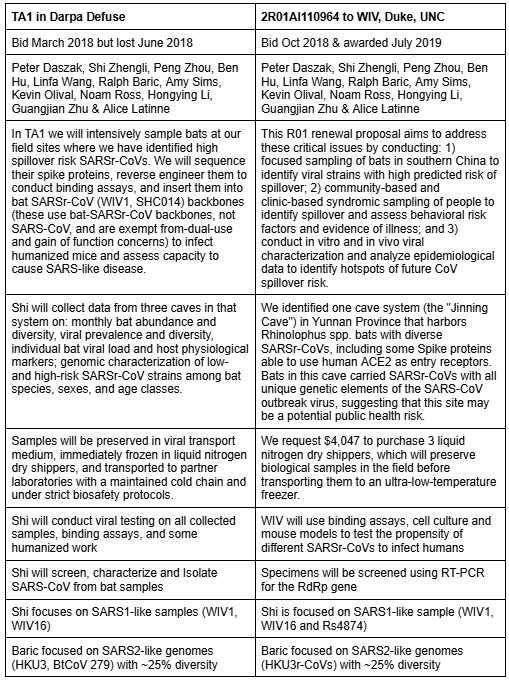
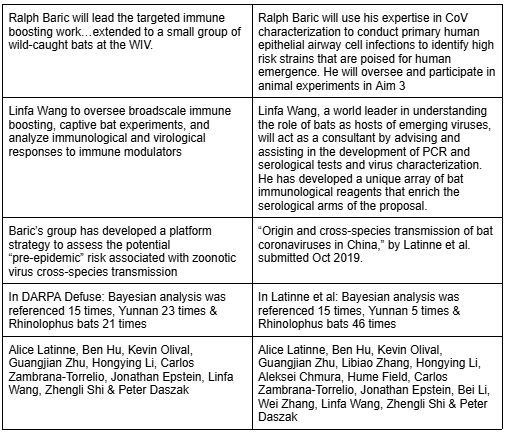
According to Daszak, Shi had already conducted a “data dump” in November 2018 containing SARS-like sequences. The 2018 DARPA Defuse Technical Area 1 (TA1) and 2019 NIAID R01 documents detail parallel fieldwork in Yunnan Province, southwest China, focusing on monitoring bat populations to collect data on SARS-related coronaviruses (SARSr-CoVs). This research involved continuous monitoring of bat populations to detect and isolate SARSr-CoVs and track changes in viral prevalence over time. Both initiatives aimed to establish baseline data to understand the dynamics of SARS-CoV interactions within bat hosts. Collaboration spanned the WIV, UNC, and Duke University, each contributing to distinct aspects of the collective research.
By July 2019, Baric became involved in her R01 research. That new R01 grant was part of Daszak’s revised DARPA Defuse grant for collecting bat samples in southern China. Their joint paper, “Origin and cross-species transmission of bat coronaviruses in China,” by Latinne et al., was submitted in October 2019. It emphasized Rhinolophus bats in Yunnan Province, employing Bayesian models referenced in DARPA Defuse.
In October 2019, Shi had a “NIAID SARS-CoV call” with Daszak, Baric, Linfa, and the rest of the team. The R01 project in Shi’s BSL2 did not include Dani’s BSL4 bat research or Baric’s BSL3 furin cleavage site research. From 2004 until 2019, this was a win-win high tide, lifting all boats’ collaboration until suddenly, it was not. What was a longtime collective enterprise quickly turned into a subtle finger-pointing game.
During the 2020 pandemic, Shi communicated with her Western collaborators, including institutions such as UNC, Rocky Mountain Lab, the University of Minnesota, Ohio State University, Colorado State University, and the Food and Drug Administration. In April 2020, James LeDuc of the UTMB contacted Shi with inquiries about a potential lab leak. Shi responded, “Due to the complicated situation, I do not think it is the right time to communicate, but I can tell you that the [SARS2] virus did not leak from our lab or any other labs.”
Shi clarified that her work at the downtown Wuchang campus only involved “low pathogenic” coronaviruses. LeDuc then requested permission in March 2020 to send Shi an infectious clone of SARS2, showing that Shi could not clone the SARS2 genome due to the limitations of her Bacterial Artificial Chromosome (BAC) reverse genetic system.
Daszak, commenting early in the pandemic, explained the complex supply chain involved in their research. He mentioned that the genetic sequences of bat viruses discovered in China were made available online through databases like GenBank and GISAID, facilitating drug testing, such as for remdesivir, without the need to culture or ship viruses internationally.
The RaTG13 sample, collected by Shi’s team in 2013 with NIAID funds, came from an abandoned copper mineshaft 1,000 miles southwest of Wuhan. The sample’s name, RaTG13, represents the bat species Rhinolophus affinis (Ra), the location of Tongguan (TG), and the year of discovery (13). It was a perfect match for Baric’s 25% criteria.
Shi uploaded fragments of the RaTG13 sequence to NIAID’s GenBank database in 2016 and 2018, although they were not released until 2022. On January 24, 2020, Shi circumvented NIAID’s GenBank embargo by releasing the complete sequence, which marked her as a whistleblower in the Wuhan lab controversy.
Shi then re-uploaded RaTG13 to GISAID. It was a password-protected database accessible to professional evolutionary virologists. One week later, on January 31, 2020, rumors of SARS2 engineering reached Fauci’s inbox, keeping the 79-year-old head of NIAID awake until 3:00 AM the following day. Baric met with Fauci two weeks later to discuss “chimeras and the outbreak.” During the NIAID meeting, Baric expressed a desire for Shi to be arrested for publishing RaTG13, since it implicated him.
In April 2020, Shi sent a blunt email to Baric stating, “We have nothing to conceal.” At the same time, another UTMB professor spread the rumor that “China is insisting the virus came from the US. But, as you can see, China is shutting down access to early samples. Seems like if we sent it over there, you’d want everyone to examine it to prove we did wrong.”
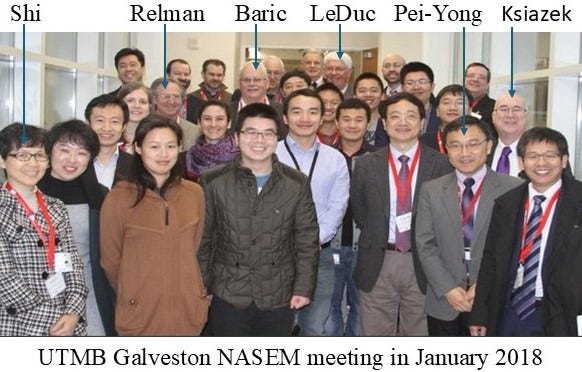
When contacted by Professor Pei-Yong Shi of UTMB, Shi Zhengli suggested they discuss the matter with “Tony Fauci.” Professor Thomas Ksiazek of UTMB replied, “I don’t think they were working with live bats; I don’t think they would have been doing this in the BSL4. From Pei-Yong’s discussions with the “bat lady,” Dr. Shi, I don’t believe that they had this virus in the lab before this started. A lot of people don’t appreciate that most of the viruses identified in bats have not been able to be grown. There are a few exceptions, but most publications are done by PCR and NGS sequencing.”
Shi never isolated the RaTG13 bat sample; it was just a genomic sequence. Although Shi was not listed on Fauci’s CREID project, she worked on the bat sample collection through an R01 grant awarded by NIAID in July 2019, which marked the formal start of DARPA Defuse. Shi’s job description in the grant was to share bat sequences with US labs. While Dani Anderson spent the next four months in Wuhan’s BSL4 lab, Shi was mostly out of the country for international conferences.
Fauci summarized Shi best: “I don’t know her. I’ve never met her. But I’ve talked to virologists who interact with her, and they say Shi’s a very talented scientist, has high integrity, and is someone whose major purpose is to prevent outbreaks from occurring. She is one of the investigators who discovered the ultimate connection of SARS-CoV-1 to the animal kingdom. I don’t think very many people recognize that. She is a member of the American Academy of Microbiology. Dr. Shi is a very well-recognized scientist.”
Shi told the BBC, “All our research results are published in English journals as papers. Virus sequences are saved in the US-run GenBank database, too. It is completely transparent. We have nothing to hide.” And “I would personally welcome any visit based on an open, transparent, trusting, reliable and reasonable dialogue. But the specific plan is not decided by me.” In the summer of 2021, Shi told The New York Times, “My lab was not involved in gain-of-function, and I did nothing wrong, so I have nothing to fear.”