
Chapter 7: An American Hero
Major Joseph Murphy's letter and DARPA Defuse

From: Murphy, Joseph P. Maj USMC, DARPA, DIRO (USA)
To: Capt xxxxx (redacted),
Thanks for responding
I’m reaching out to communicate information about COVID that I don’t believe you or your director is aware of. You probably saw earlier this week [of September 2021] that more official documents linking NIH and EcoHealth Alliance to the Wuhan Institute of Virology were published by The Intercept. I came across additional incriminating documents and produced an analysis after leaving DARPA last month. This report was routed to the Department of Defense Inspector General’s office.
I’m unsure whether those who received the report understand the significance of what I communicated. Decisions concerning the vaccines do not appear to be informed by analysis of the documents. The main points are that SARS-CoV-2 matches the SARS vaccine variants the NIH-EcoHealth program was making in Wuhan, that the Department of Defense (DoD) rejected the program proposal because vaccines would be ineffective, and because the spike proteins being inserted into the variants were deemed too dangerous (gain-of-function): and that the DoD now mandates vaccines that copy the spike protein previously considered to be too risky. To me and those who informed my analysis, this situation meets gain-of-function criteria regarding the vaccines until the toxicity of the spike protein can be investigated. There’s also information within the documents about which drugs effectively treat the program’s SARS-CoVs.
Thus, I’m reaching out. I’m trying to provide as much information as possible to help leadership grapple with the vaccines and the mandate. I wanted to push this information your way.
Several of the documents referenced in the Inspector General report have since been downgraded. Please reach out to me with questions.
V/R,
Major Joe Murphy, USMC Marine Program Liaison
Office of Naval Research
Major Joseph Murphy from the US military was frustrated at the lack of response to his August 2021 letter (below). So, he wrote an undated cover letter (above) sometime after September 6, 2021, but before he leaked the DARPA Defuse documents by September 21, 2021. In 2020, The Intercept sued NIAID to obtain two 2019 EcoHealth grants: the $3.2 million R01 and the $7.5 million U01.
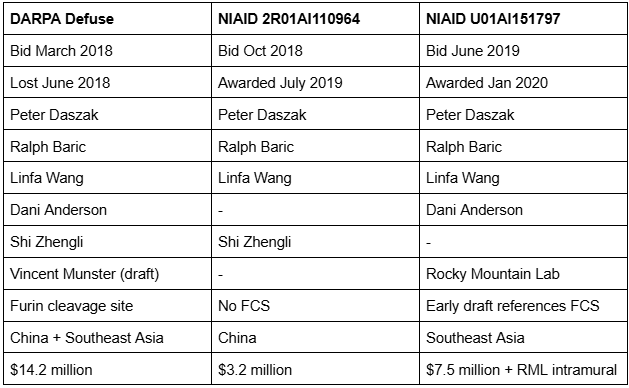
On September 6, 2021, The Intercept published 900 pages of documents related to these two NIAID grants. Murphy noticed that the same personnel involved in the NIAID R01 and U01 grants—Peter Daszak, Ralph Baric, Linfa Wang, Dani Anderson, and Shi Zhengli—were also listed in the 2018 DARPA Defuse document.
The 2021 Intercept Freedom of Information Act (FOIA) revealed the NIAID documents, though they were overshadowed by DARPA Defuse news in Fall 2021. Ironically, Major Murphy leaked the DARPA Defuse documents after reading The Intercept FOIA.
The Intercept noted the U01 CREID proposal, “written in 2019, often seems prescient, focusing on scaling up and deploying resources in Asia in case of an outbreak of an emergent infectious disease and referring to Asia as the hottest of the EID hotspots.” The Intercept also highlighted, “Instead of sending viral samples to the Wuhan Institute of Virology, which is not a partner on this CREID project, the scientists will send the collected [coronavirus] samples to the [Rocky Mountain Lab where Baric and Daszak have ongoing collaborations], the National Emerging Infectious Diseases Laboratories in Boston, and the University of North Carolina at Chapel Hill.” Weeks later, The Intercept also published the DARPA Defuse documents. Months later, Project Veritas published Murphy’s letter.
The leaked documents and Major Murphy’s revelations have shed light on the potential origins of SARS2, suggesting that a well-intentioned but high-risk research project inadvertently led to a global pandemic. Murphy found the DARPA Defuse document in a top-secret US government folder.
The renewed $3.2 million NIAID R01 grant added Baric in 2019. The new $7.5 million U01 CREID grant was undergoing testing for most of 2019. In early 2020, Daszak bid on another $3.4 million NIAID grant in Laos, bringing his total to $14.1 million from NIAID to cover the $14.2 million Defuse bid. These three NIAID grants covered China and Southeast Asia with the same scope of work.
Murphy’s original August 2021 letter continues below, referencing the 2019 grant ($3.2M) canceled by President Trump in April 2020. Trump truthfully claimed the grant started in 2015 under the Obama administration, but Fauci renewed it in 2019 with DARPA Defuse language. None of us knew it at the time; it partially funded the creation of Covid-19 on US soil.
On a personal note, when Major Joseph Murphy wrote his August 2021 letter, I believed that Covid was a self-spreading PLA-made biodefense vaccine intended for Chinese troops. Murphy attempted to explain to US military doctors that the human virus was, in fact, an airborne bat vaccine!
13 August 2021
From: COMMANDANT OF THE MARINE CORPS FELLOW, DARPA
TO: INSPECTOR GENERAL
Subject: SARS-CoV-2 ORIGINS INVESTIGATION WITH US GOVERNMENT PROGRAM UNDISCLOSED DOCUMENT ANALYSIS
1) SARS-CoV-2 is an American-created recombinant bat vaccine or its precursor virus. It was created by an EcoHealth Alliance program at the Wuhan Institute of Virology (WIV), as suggested by the reporting surrounding the lab leak hypothesis. The details of this program have been concealed since the pandemic began. These details can be found in the EcoHealth Alliance proposal response to the DARPA PREEMPT program Broad Agency Announcement (BAA) HR001180017, dated March 2018 - a document not yet publicly disclosed.
The proposed program’s contents are extremely detailed. Peter Daszak outlines step-by-step what the organization intends to do by phase and location. The primary scientists involved, their roles, and their institutions are indicated. The EcoHealth plan for the Wuhan Institute of Virology work is in the attached DARPA Defuse document.
SARS-CoV-2’s form, as it emerged, is likely as a precursor, deliberately virulent, humanized recombinant SARSr-CoV that was to be reverse-engineered into a live attenuated SARSr-CoV bat vaccine. Its nature can be determined from the analysis of its genome with the context provided by the EcoHealth Alliance proposal. Joining this analysis with US intelligence collections on Wuhan will aid this determination.
When synthesized with the EcoHealth Alliance proposal, US collections confirm that EcoHealth Alliance performed the proposed work. The analysts produce their reports in a vacuum absent the context the proposal provides. As a fellow at DARPA, I can see both and do the synthesis. For instance, WIV personnel identified in intelligence reports are named in the proposal; these people use the lexicon of the proposal in the collections, and the virus variants proposed for experimentation are identical to those gleaned by collections. Moreover, I am also privy to information obtained by congressional office investigators and DRASTIC, which further corroborates that the program detailed in the BAA response was conducted until it was shut down in April 2020.
The purpose of the EcoHealth program, “DEFUSE” in the proposal, was to inoculate bats in the Yunnan China caves where confirmed SARS-CoV were found. Ostensibly, doing this would prevent another SARS-CoV pandemic: the bats’ immune systems would be reinforced to prevent a deadly SARS-CoV from emerging. The specific language used is “inoculate bats with novel chimeric polyvalent spike proteins to enhance their adaptive immune memory against specific high-risk viruses.” Being defense-related, it makes sense that EcoHealth submitted the proposal first to the Department of Defense before it settled with NIH/NIAID. The BAA response is dated March 2018 and was submitted by Peter Daszak, president of EcoHealth Alliance.
DARPA rejected the proposal because the work was too close to violating the gain-of-function (GOF) moratorium, despite what Peter Daszak says in the proposal (that the work would not). As is known, Dr. Fauci with NIAID did not reject the proposal. The work took place at the WIV and several US sites, which are identified in detail in the proposal.
The EcoHealth Alliance response to the PREEMPT BAA is placed along with other proposal documents in the PREEMPT folder on the DARPA Biological Technologies Office UWICS (top secret share drive, address: Network/filer/BTO/CI Folder/PREEMPT)
This folder was empty for a year. The files, completely unmarked with classification or distribution data, were placed in this folder in July 2021, which conspicuously aligns with media reporting, my probing, and Senator Paul’s inquiry into NIH/NIAID gain-of-function programs. The unmarked nature combined with the timing signals that the documents were being hidden. No files at DARPA go unmarked in classification or distribution, including proprietary documents. Furthermore, PREEMPT is an unclassified program. The files are also now held by the Marine Corps Intelligence Activity (MCIA). They are identified in the reference block above.
2) SARS-CoV-2, hereafter referred to as SARS-CoV-WIV, is a synthetic spike protein chimera engineered to attach to human ACE2 receptors and inserted into a recombinant bat SARSr-CoV backbone. It is likely a live vaccine that has not yet been engineered to a more attenuated state than the program sought to create with its final version. It leaked and spread rapidly because it was aerosolized so it could efficiently infect bats in caves, but it was not ready to infect bats yet, so it does not appear to infect bats. The disease is confusing because it is less a virus than engineered spike proteins hitch-hiking a ride on a SARSr-CoV quasi-species swarm. The closer it is to the final live attenuated vaccine form, the more likely it has been de-attenuating since its initial escape in August 2019.
The utility of certain countermeasures can be extrapolated from the documents:
The team selected SARSr-CoVs that were the most monoclonal antibody and vaccine-resistant.
It is not practical to inoculate bats directly with shots, nor can bats get respiratory infections from droplets. Hence, the team developed an aerosol to deliver the inoculations directly into the caves. To ensure it worked well, they developed the aerosol against masked civets.
The proposal notes that interferon, remdesivir, and chloroquine phosphate inhibit SARSr-CoV viral replication.
Because of its (now) known nature, the SARSr-CoV-WIV illness is readily resolved with early treatment that inhibits the viral replication that spreads the spike proteins around the body (which induces a harmful overactive immune response as the body tries to clear the spikes from the ACE receptors). Many of the early treatment protocols ignored by the authorities work because they inhibit viral replication or modulate the immune response to the spike proteins. This makes sense within the context of what EcoHealth was creating. Some of these treatment protocols also inhibit the action of the engineered spike protein. For instance, Ivermectin (identified as curative in April 2020) works throughout all illness phases because it inhibits viral replication and modulates the immune response. Of note is that chloroquine phosphate (Hydroxychloriquine, identified April 2020 as curative) is identified in the proposal as a SARSr-CoV inhibitor, as is interferon identified May 2020 as curative).
The gene-encoded, or mRNA, vaccines work poorly because they are synthetic replications of the already-synthetic SARSr-CoV-WIV spike proteins and possess no other epitopes. The mRNA instructs the cells to produce synthetic copies of the SARSr-CoV-WIV synthetic spike protein directly into the bloodstream, spreading and producing the same ACE2 immune storm that the recombinant vaccine does. Many doctors in the country have identified that the symptoms of vaccine reactions mirror the symptoms of the disease, which corroborates with the similar synthetic nature and function of the respective spike proteins. The vaccine recipient has no defense against bloodstream entry, but their nose protects them from the recombinant spike protein quasi-species during “natural infection” (better termed as aerosolized inoculation).
Furthermore, the EcoHealth proposal states that a “vaccine approach lacks sufficient epitope coverage to protect against quasi-species of coronavirus.” Consequently, they tried to make vaccines work by “targeted immune boosting via vaccine inoculators using chimeric polyvalent recombinant spike proteins.” The nature of using a spike protein vaccine with one epitope against a spike protein vaccine with quasi-species may explain the unusual (and potentially detrimental) antibody response amongst the vaccinated to the new COVID variants. Fundamentally, the knowledge the proposal provides signals that the risk of Antibody-Dependent Enhancement (ADE from vaccination should be evaluated with high priority, on top of the reality that single-epitope vaccines will have little effect against SARS-CoV-WIV, as indicated in the proposal.
The potential for SARSr-CoV-WIV to de-attenuate requires immediate attention. Live vaccines have been found to de-attenuate in the past. Suppose this is the case with SARS-CoV-WIV. Then, the mass vaccination campaign performs an accelerated gain-of-function. Since it is designed for bats from a human-susceptible SARS-CoV, vaccinating humans against it returns its function towards a more de-attenuated human-susceptible form. Improving the SARSr-CoV-WIV spike protein to gain robustness against monoclonal vaccines is one of the steps of the DEFUSE program. The mechanism to improve the SARSr-CoV-WIV spike protein (other than direct engineering) is challenging it against animals with spike protein-only antibodies. The attenuated virus will either die or adapt its form to neutralize the spike protein-only antibodies. The intent was to perform this task against humanized mice and then “batified” mice. Instead, it was done with the world’s population.
SARS-CoV-WIV is not meant to kill the bats but to immunize them. This nature may explain its general harmlessness to most people and its harmfulness to the old and co-morbid, who are generally more susceptible to vaccine reactions. The asymptomatic nature is also explained by the bat vaccine’s creators’ intention (a good vaccine does not generate symptoms). Such effects would be expected of an immature vaccine or a vaccine being reverse-engineered from a more virulent form into an attenuated form. The spike protein effect on ACE receptors exacerbates the harmfulness of age and comorbidity. The nature of SARSr-CoV-WIV’s de-attenuation will also indicate future virulence, though knowing its nature, at last, neutralizes the threat as effective treatments can be applied with confidence.
3) DRASTIC and other scientists will clean up my description of SARS-CoV-WIV’s nature and progression within the DEFUSE program. This information is sufficient for an investigative report and enough to correct the existing pandemic strategy. Previously, the nation did not know itself, nor the adversary in the pandemic conflict. Now it knows both. The problem can be framed appropriately and specifically against a confirmed hypothesis. Limiting disease transmission can be dropped as the implied strategic end, as it is neither the actual problem nor feasible. The strategy will then align early treatment protocols and prevention with the known curatives as ways and means. This course of action will achieve the strategic end of clinical resolution for those susceptible to SARS-CoV-WIV inoculation’s adverse effects.
4) I will inevitably be asked how I figured this out and discovered the documents. The pandemic response became the predominant focus of my fellowship efforts. DARPA worked on many pandemic innovations, and much of its team was familiar with biodefense. I had the opportunity to “sit in the back row” per se and observe and listen in on the government’s efforts. My obligation-light fellowship also allowed me to observe and read the field. This observation grew in scope to the point that it became a series of reports like a military scout would prepare when tasked to investigate a problem.
These reports served as iterative thinking against the problem over many months. Eventually, I concluded that what leaked from the WIV could be a bat vaccine or its precursor. It was feasible that the US would try to avoid a SARS-CoV outbreak by stopping it at its source, not by halting its infections amongst people, but by halting its infections amongst the bats. Americans are creative, even if imprudent, and technologically confident enough to try it. This concept seemed to fit within the PREEMPT program construct as well, and DRASTIC had discovered that some earlier specimens within the USAID PREDICT program were obtained in Africa and sent to the WIV. Moreover, the unusual nature and pathology of the virus hinted that it could be a vaccine or be vaccine-like.
A technological challenge as difficult as inoculating bats in China would be tried at DARPA first. The massive “Manhattan Project”-level of information suppression executed by the government and the Trusted News Initiative indicates that it would be covered up if something bad happened. The lab-leak hypothesis and squabbling between Senator Paul and Dr. Fauci indicated that the cover-up was more localized. Further, an actual cover-up would be more disciplined with its paperwork. So, I presumed that unclassified files would be concealed on a higher network and found them where I expected them. I understood what they were and their content, pushed the files off-site, and compiled this report.
Semper Fi
U.S. Marine Corp Major Joseph Murph
DARPA Defuse bid
24 March 2018
From: Peter Daszak, President, EcoHealth Alliance
To: DARPA PREventing EMerging Pathogenic Threats (PREEMPT)
Subject: Project Defuse
Amount of the Requested Proposal: $14,209,245 across 3.5 years
The book author’s comments are italicized, and important evidence is bolded:
Security concerns across Asia make the region a potential deployment site for US warfighters. Troops face increased disease risk from SARSr-CoVs, which are shed via urine and feces as bats forage at night.
Our work in Yunnan, China shows that: 1) bat SARSr-CoVs exist that can infect human cells, produce SARS-like illness in humanized mice, and are not affected by monoclonal or vaccine treatment; and 2) bat SARSr-CoV host-jump into local human populations is frequent. These viruses are therefore a clear and present danger to US defense forces in the region and global health security.
Our goal is to analyze, predict, then “DEFUSE” the spillover potential of novel bat-origin high-risk SARSr-CoVs in Southeast Asia and across these virus distributions. This will safeguard the US warfighter, reduce risk for local communities and their livestock, improving food and global health security.
Our strategy is based on immune parameters found across all bat taxonomic groups. If successful, the DEFUSE approach can be adapted to MERS-CoV in the Middle East, other SARSr-CoVs in Africa, and other high-impact bat-origin viruses (e.g., Hendra, Nipah, Ebola, Marburg viruses). No technology exists to reduce exposure to novel bat CoVs.
Our team has conducted pioneering research modeling disease emergence understanding CoV virology, bat immunity, and wildlife vaccine delivery. Previous work provides proof of concept for: 1) predictive hotspot modeling, 2) upregulating bat immune response through the STING interferon pathway, 3) recombinant chimeric spike-proteins from SARSr-CoVs; 4) molecule delivery to wildlife including bats.
DEFUSE approach is based on immunological patterns found across bat families, therefore will be broadly effective, scalable, economical and achievable in the allotted time frame. It poses little environmental risk, and presents no threat to the warfighter, or non-target populations.
Immune modulation (via self-spreading vaccines) is more likely to be effective than CRISPR-Cas9 gene drives (sexual transmission) because bats are relatively long-lived, highly mobile, and have long inter-generational periods (2-5 years) with low progeny (1-2 pups).
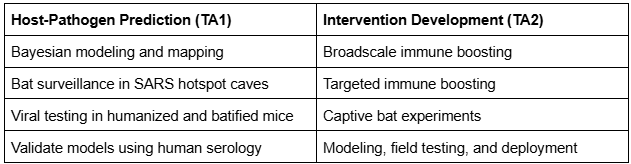
Host-Pathogen Prediction (TA1) or NIAID 2R01AI110964 in Shi’s BSL2:
Integrated field sampling, viral characterization, modeling: In-depth sampling of bat SARSr-CoVs in high-risk sites of active spillover, Yunnan, China. Spatial models using bat and viral data to estimate SARSr-CoV jump potential across Asia. Spatial viral spillover risk Mobile App of background viral jump risk across Asia.
Experimental assays to test jump potential: Sequence quasispecies spike protein similarity to high-risk SARSr-CoVs, model spike structure to assess ACE2 binding, then in vitro and ACE2 humanized mouse experiments. Use results to test machine learning genotype to phenotype model predictions of viral spillover risk.
Intervention Development (TA2) or NIAID U01Al151797 in Dani’s BSL4:
Broadscale immune boosting: inoculate bats with immune modulators to upregulate their naturally inhibited innate immunity and suppress viral replication, transiently reducing viral shedding/spillover risk.
Targeted immune boosting: In concert with the above, inoculate bats with novel chimeric polyvalent recombinant spike proteins to enhance their adaptive immune memory against specific, high-risk viruses.
Viral dynamics: Develop stochastic simulation models to estimate the frequency, efficacy, and population coverage required for intervention approaches to effectively suppress the viral population.
Field trial: Use team expertise in wildlife vaccine delivery (transdermal nanoparticles, raccoon poxvirus vector) to develop effective molecule delivery via automated aerosolization onto bats at the roost entrance at our three test cave sites in a cave complex in Yunnan, China, where SARSr-CoVs have infected people.
Technical Approach: Our goal is to defuse the potential for spillover of novel bat-origin high zoonotic risk SARS-related coronaviruses in Asia. In Technical Area 1 (TA1) or NIAID 2R01AI110964 awarded in 2019, we will intensively sample bats at our field sites where we have identified high spillover risk SARSr-CoVs. We will sequence their spike proteins, reverse engineer them to conduct binding assays, and insert them into bat SARSr-CoV (WIV1, SHC014) backbones (these use bat-SARSr-CoV backbones, not SARS-CoV, and are exempt from-dual-use and gain of function concerns) to infect humanized mice and assess capacity to cause SARS-like disease. Our modeling team will use these data to build machine learning genotype-phenotype models of viral evolution and spillover risk. We will uniquely validate these with serology from previously collected human samples via LIPS assays that assess which spike proteins allow spillover into people. We will build host-pathogen spatial models to predict the bat species composition of caves across Southeast Asia (R01AI163118 in Chapter 21) with a full inventory of host-virus distribution at our field test sites, three caves in Yunnan Province, China and a series of unique global datasets on bat host-viral relationships discussed in Chapter 17.
In Technical Area 2 (TA2) or NIAID U01Al151797 evaluated in 2019, we will evaluate two approaches to reduce SARSr-CoV shedding in cave bats: (1) Broadscale immune boosting, in which we will inoculate bats with immune modulators to upregulate their innate immune response and downregulate viral replication; (2) Targeted immune boosting, in which we will inoculate bats with novel chimeric polyvalent recombinant spike proteins plus the immune modulator to enhance innate immunity against specific, high-risk viruses. We will trial inoculum delivery methods on captive bats, including a novel automated aerosolization system, transdermal nanoparticle application, and edible adhesive gels. We will use stochastic simulation modeling informed by field and experimental data to characterize viral dynamics in our cave test sites, maximize timing, inoculation protocol, delivery method, and efficacy of viral suppression. The most effective biologicals will be trialed in our test cave sites in Yunnan Province, with a reduction in viral shedding as proof of concept discussed in Chapter 18.
We and others have demonstrated proof of concept of this phenomenon: Experimental Marburg virus infection of Egyptian fruit bats at the US CDC, a natural reservoir host, resulted in wide tissue distribution yet low to moderate viral loads, brief viremia, low seroconversion, and a low antibody titer that waned quickly, suggesting no long-term protection is established. Similarly, poor neutralizing antibody responses occur after experimental infection of bats with Tacaribe virus and in our studies with SARS-CoV experimentally infected Chinese bats (Linfa Wang, unpublished 2005 data). Indeed, we successfully showed bat interferon can inhibit bat SARSr-CoVs. We hypothesize that if we can use immune modulators that upregulate bats’ naturally low innate immunity to their viruses, we can transiently suppress viral replication and shedding, reducing the risk of spillover. We will evaluate two immune modulation approaches to defuse spillover of SARSr-CoVs from bats to humans: 1) Broadscale Immune Boosting strategies (Wang, Duke-NUS): we will apply immune modulators like TLR-ligands, small molecule Rig like receptor agonists or bat interferon in live bats, to upregulate their innate immunity and assess suppression of viral replication and shedding; 2) Targeted Immune Priming (Baric, UNC): the broadscale immune boosting approach will be applied in the presence and absence of chimeric immunogens to boost clearance of high-risk SARSr-CoVs discussed in Chapter 11.
Broadscale immune boosting (led by Wang, Duke-NUS). We will work on the following key leads to identify the most effective approach to upregulate innate immunity and suppress viral loads. Toll-like receptor (TLR)/Rig-I Like Receptor ligands: We have begun profiling bat innate immune activation in vivo in response to various stimuli. Our work indicates a robust response to TLR-stimuli like polyI:C when delivered in vivo, as measured by transcriptomics on spleen tissue (Figure 8) which is discussed in Chapter 12.
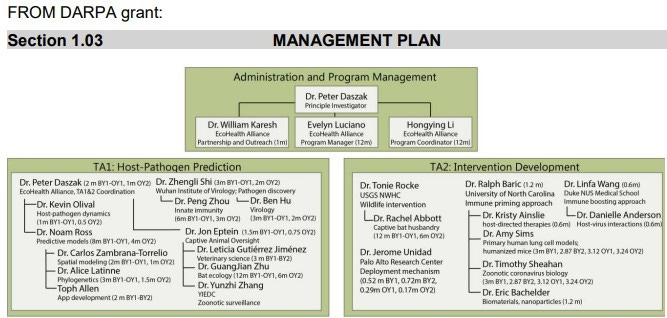
Dr. Danielle Anderson is the Scientific Director of the Duke-NUS Animal BSL3 laboratory and is an expert in RNA virus replication. Dr Anderson has extensive experience in both molecular biology and animal models and will lead the animal studies via U01Al151797 discussed in Chapter 10.
Prof. Shi is the director of the Center for Emerging Infectious Diseases of the Wuhan Institute of Virology, Chinese Academy of Sciences. She got PhD training in Virology in Montpellier University II from 1996 to 2000, biosafety training at Australian Animal Health Laboratory in May 2006 and at Lyon P4 in October 2006. She is now in charge of the scientific activity in BSL3 and BSL4 of the WIV via 2R01AI110964 discussed in Chapter 13.
Subcontracts:
Prof. Baric, UNC, will oversee reverse engineering of SARSr-CoVs, BSL-3 humanized mouse experimental infections, design and testing of targeted immune boosting treatments.
Prof. Wang, Duke-NUS, to oversee broadscale immune boosting, captive bat experiments, and analyze immunological and virological responses to immune modulators.
Dr. Shi, WIV, will conduct PCR testing, viral discovery, isolation from bat samples collected in China, spike protein binding assays, humanized mouse work, and experimental trials on Rhinolophus bats.
Dr. Rocke, US Geological Service (USGS), National Wildlife Health Center (NWHC) in Wisconsin, will refine delivery mechanisms for immune boosting treatments. Dr. Rocke will use a captive colony of bats at NWHC for initial trials and oversee cave experiments in the US and China.
Dr. Unidad, Palo Alto Research Center (PARC), will develop an innovative aerosol platform into a field deployable device for large scale inoculation of bats.
NIH Rocky Mountain Lab (RML) - Vincent Munster removed from Defuse bid for unknown reasons but added in NIAID’s U01Al151797.
Prof. Baric (UNC) will lead the targeted immune boosting work. We will develop recombinant chimeric spike-proteins from known SARSr-CoVs, and those characterized by DEFUSE. Using details of SARS Spike protein structure and host cell binding, we will sequence, reconstruct, and characterize spike trimers and receptor binding domains of SARSr-CoVs, incorporating them into nanoparticles or raccoon poxvirus-vectors for delivery to bats. In combination with immune-boosting small molecules, we will use these to boost immune memory in adult bats previously exposed to SARSr-CoVs, taking the best candidate forward for field testing. Recombinant Spike glycoprotein-based constructs with immunogenic blocks from across group 2B SARSr-CoVs should induce broadscale adaptive immune responses that reduce heterogeneous virus burdens in bats and transmission risk to people. Innate immune damping is highly conserved in all bat species tested so far. We will use the unique Duke-NUS Asian cave bat (Eonycteris spelaea) breeding colony to conduct initial proof of concept tests extended to small groups of wild-caught Rhinolophus sinicus bats at WIV discussed in Chapter 14.
Targeted immune boosting (UNC). To boost targeted adaptive immunity (immune memory) in wild bats chronically exposed to circulating SARSr-CoV quasispecies, we will inoculate with chimeric glycoproteins in the presence of the broadscale immune boosting agonists above. We have developed novel group 2b SARSr-CoV chimeric Spike glycoproteins that encode neutralizing domains from phylogenetically distant strains (e.g. Urbani, HKU3, BtCoV 279, ~25% diversity). The chimeric Spike protein (~4,000 nucleotides) programs efficient expression when introduced in the HKU3 backbone full length genome (~30,000 nucleotides) and elicits protective immunity against multiple group 2b strains. We will develop robust expression systems for SARSr-CoV chimeric Spike using ectopic expression in vitro. Given the breadth of SARSr-CoV circulating in natural settings, chimeric immunogens will be designed to increase the breadth of neutralizing epitopes across the group 2b phylogenetic subgroup. Using synthetic genomes and structure guided design, we fused the NTD of HKU3 with the SARS-CoV RBD with the remaining BtCoV 279/04 Spike glycoprotein molecule, introduced the chimeric Spike glycoprotein gene into the HKU3 genome backbone (25% different than SARS-CoV, clade 2 virus) and recovered viable viruses (HKU3-Smix) that could replicate in Vero cells. We inserted the HKU3mix Spike glycoprotein gene into VEE virus replicon vectors (VRP-Spike chimera) and demonstrated that VRP vaccines protect against lethal SARS-CoV challenge and virus growth. VRP-SHKU3 and VRP-S279 both protect against HKU3mix challenge and growth in vivo, demonstrating that neutralizing epitopes in the HKU3mix Spike glycoprotein provide broad cross protection against multiple SARSr-CoV strains. In addition to using these immunogens as a targeted broad-based boosting strategy in bats, we will produce other chimeras for more focused immune targeting of known high risk strains discussed in Chapter 22.
UNC will characterize Spike expression and provide virus vectors to Prof. Wang for immune boosting trials at Duke-NUS and, if successful, in the field (Prof. Shi). The human codon optimized HKU3-Spike S014 and HKU3-Smix recombinant chimeric spike glycoproteins will be expressed and purified by the UNC proteomics core, producing mg quantities for inclusion in nanoparticle and microparticle carriers in collaboration with Dr. Ainslie of UNC. We will produce WIV-S S014, and HKU3-Smix glycoprotein expression will be validated by Western blot and by vaccination of mice, allowing us to determine if the recombinant protein elicits neutralizing antibodies that protect against lethal SARS-CoV and SHC014 challenge. We will produce enough material for in vivo testing in mice and in bats discussed in Chapter 23.
Recovery of Full length SARSr-CoV. To recover full length viruses, UNC will first compile the sequence data from a panel of closely related strains (<5% nucleotide variation) and compare the full length genome sequences, scanning for unique SNPs which might represent sequencing errors as previously described by our groups. We will identify the best consensus candidate and synthesize the genome using commercial vendors (e.g., BioBasic, etc.) as six contiguous cDNA pieces linked by unique restriction endonuclease sites that do not disturb the coding sequence but allow for full length genome assembly. Full length genomes will be transcribed into RNA and electroporation is used to recover full length recombinant viruses. Using the full length genomes, we will re-evaluate virus growth in primary human airway epithelial cells at low and high multiplicity of infections and in vivo in hACE2 transgenic mice, testing whether backbone genome sequence alters full length SARSr-CoV pre-epidemic or pathogenic potential in models of human infection. We anticipate recovering 2-5 full length genomes per year, reflecting strain differences in antigenicity, receptor usage, growth in human cells and pathogenesis covered in Chapter 24.
Proteolytic Cleave and Glycosylation Sites. In some instances, recombinant chimeric viruses may be predicted to replicate efficiently because of matched RBD-ACE2 interfaces, yet fail to replicate. After receptor binding, cell surface or endosomal proteases cleave the SARS Spike glycoprotein to activate fusion mediated entry. Massive changes in Spike structure occur to mediate membrane fusion and entry. The absence of Spike cleavage prevents SARS-CoV entry via R01AI110700. A variety of proteases, including TMPRSS2, TMPRSS11a, HAT, trypsin, and cathepsin L, carry out these processes on the SARS Spike glycoprotein (Figure C at the S1/S2 interface). In some instances, tissue culture adaptations introduce a furin cleavage site, which can direct entry processes as well, usually by cleaving Spike at positions 757 and 900 in S2 of other coronaviruses, but not SARS. For SARS-CoV, a variety of key cleavage sites in Spike have been identified, including R667/S668, R678/M679 for trypsin and cathepsin L, respectively, R667 and R792 for TMPRSS2, and R667 for HAT. Discussed in Chapter 23 since R667 is the S1/S2 interface of SARS1 and RRAR/SVAS for SARS2.
Organization leading task: University of North Carolina
SARSr-CoV Spike gene sequences will be analyzed for the presence of these appropriately conserved proteolytic cleavage sites in S2 and the presence of potential furin cleavage sites (R-X-[K/R]-R↓), which can be predicted computationally. Importantly, SARSr-CoV with mismatches in proteolytic cleavage sites can be activated by exogenous trypsin or cathepsin L, providing another strategy to recover non-cultivable viruses. In instances where clear mismatches occur in these S2 proteolytic cleavage sites of SARSr-CoV, we will introduce the appropriate human specific cleavage sites and evaluate growth potential in Vero and Human Airway Epithelial (HAE) cultures. In SARS-CoV, we will ablate several of these sites based on pseudotype particle studies and evaluate the impact of select SARSr-CoV changes on virus replication and pathogenesis (e.g., R667, R678, R797). Experimental outcomes from these studies will be incorporated into risk management models to identify high and low risk SARS-like CoV covered in Chapter 22.
Baric has already generated SARS-like chimeras w/ RBD from a group of bat viruses called 293 for S1 (typo per Baric), which is 20% different from epidemic strains (SARS1), and the S2 region from HK3 (HKU3 per Baric), which is 20% different from SARS1 and discussed in Chapter 23 and Post DARPA Defuse Bibliography.
Viral infection models in Eonycteris species (Duke-NUS) and wild-caught Rhinolophus species (WIV) bats: To test and compare the efficacy of the immune modulating approaches above, we will use our cave nectar fruit bats (Eonycteris spelaea) breeding colony infected with Melaka virus (family Reoviridae) which infects this species. First, we will take wing punch biopsies from three individuals to sequence their ACE2 receptor genes. This will be inserted into human cell lines to pre-screen viral strains for binding. Those that bind will be used for in vivo experiments. We will use two coronaviruses (SARSr-CoV WIV1 at RML and MERS-CoV) in animal BSL3. SARS and MERS infection studies are underway in Eonycteris and Pteropus cell lines and primary immune cells. Our cave nectar fruit bat colony has reached a sustainable population for infection experiments and the animal BSL3 facility has been outfitted with bat-specific cages. The planned pilot in vivo infection of Eonycteris bats with Melaka Virus and MERS will be completed by July 2018. Previous infection studies were completed in Pteropus and Rhinolophus bats in Australia by Linfa Wang at CSIRO, AAHL, and an additional Pteropus infection trial is currently planned through the University of Queensland in Australia. At WIV, 20 adult wild Rhinolophus species bats (10 of each sex) will be captured at our test cave site, housed within animal BSL3, ACE2 receptor genes sequenced and used to pre-screen spikes as above. Bats will be tested using PCR and serology for current and prior exposure to SARSr-CoVs, and inoculated with WIV1 experiment at RML, WIV16 or SHC014. For all experiments, viral loads will be measured by qPCR, titration of produced virus, NGS transcriptomics and viral-specific nanostring probes added to the immune profiling panel. Antibody responses will be measured by LIPS assay, as described previously. In addition to direct in vivo delivery of ligands, aerosolized and liquid-phase deployment methods suitable for a cave-like environment will be tested in collaboration with UNC, NWHC, and PARC. This approach allows us to test our immune-boosting strategies in a safe and controlled environment prior to expanding to field-based evaluation discussed in Chapter 26.
Finally, work on a field delivery method will be overseen by Dr. Tonie Rocke at USGS, NWHC, who has proven capacity to develop and take animal vaccines through to licensure. Using locally acquired insectivorous bats like Tadarida brasiliensis or Eptesicus fuscus as proxies, Dr. Rocke will further develop and assess delivery vehicles (mediums) and methods of delivery for the molecules, inocula proposed above, including: 1) transdermally applied nanoparticles; 2) sticky edible gels that bats will groom from themselves and each other; 3) aerosolization via sprayers that could be used in cave settings; and 4) automated sprays triggered by timers and movement detectors at critical cave entry points in Chapter 27-28.
Summary of post-pandemic test results:
SARS2 genome (i.e., HKU3mix or HKU3r-CoV) is 20% different from SARS1.
SARS2 is the only group 2b coronavirus with a furin cleavage site.
RaTG13 and Banal-52 are less than 5% nucleotide variation from SARS2.
Covid antibodies provide protection against Laos Banal infection.
SARS2 has six contiguous cDNA pieces linked by five restriction sites.
Mexican free-tailed bats (Tadarida brasiliensis) are infected with SARS2.
Egyptian fruit bats (Rousettus aegyptiacus) are a reservoir host for SARS2.
More details are below.

Fauci funded DARPA Defuse for $14.1M

The last post was months ago, but one question remained: Did Peter Daszak of EcoHealth resubmit his $14.2 million DARPA Defuse bid? Daszak dodged the question in his congressional interview, but like Fauci said, Daszak never resubmitted “that” March 2018 proposal. That proposal included plans to test novel coronaviruses with furin cleavage sites on live…
The Daszak files he hid from Congress

For years, Fauci defended EcoHealth’s Wuhan subgrant with one line: the studied viruses were “molecularly impossible” to have created SARS-CoV-2.
Wow, the part about the DoD rejecting the program initially really stood out to me. If those documents are so clear, how can we ensure such critical findings are always transparently integreated into public health decisions?
Great work thank you very much. It is of utmost importance to achieve transparency in this catastrophe.