
MERS-MA30: Haslam vs Drosten
When the student challenged the Master

We opened our 2025 WHO SAGO letter with evidence that I didn’t even include in my 2024 book: MERS-MA30. In retrospect, it may have been the missing piece.
According to his 2018-19 documents, Ralph Baric at UNC created a SARS-like genome that triggered an immune response in mammals—he even cited the “precise molecular blueprint for SARS-CoV-2.”
Baric referenced a PRRVR furin cleavage site in 2019, while SARS2 emerged with PRRAR. That precise molecular blueprint, called MERS-MA30, was found by computational biologist Andreas Martin Lisewski. We interviewed him in 2024, and you can find that Substack link in the latest 2026 PNAS publication!

https://www.pnas.org/doi/10.1073/pnas.2601806123
Christian Drosten—the Baric of Germany—initially appeared receptive to the evidence presented by Lisewski. Since then, however, he seems to have changed course and is now attempting to debunk the very theory he once entertained.
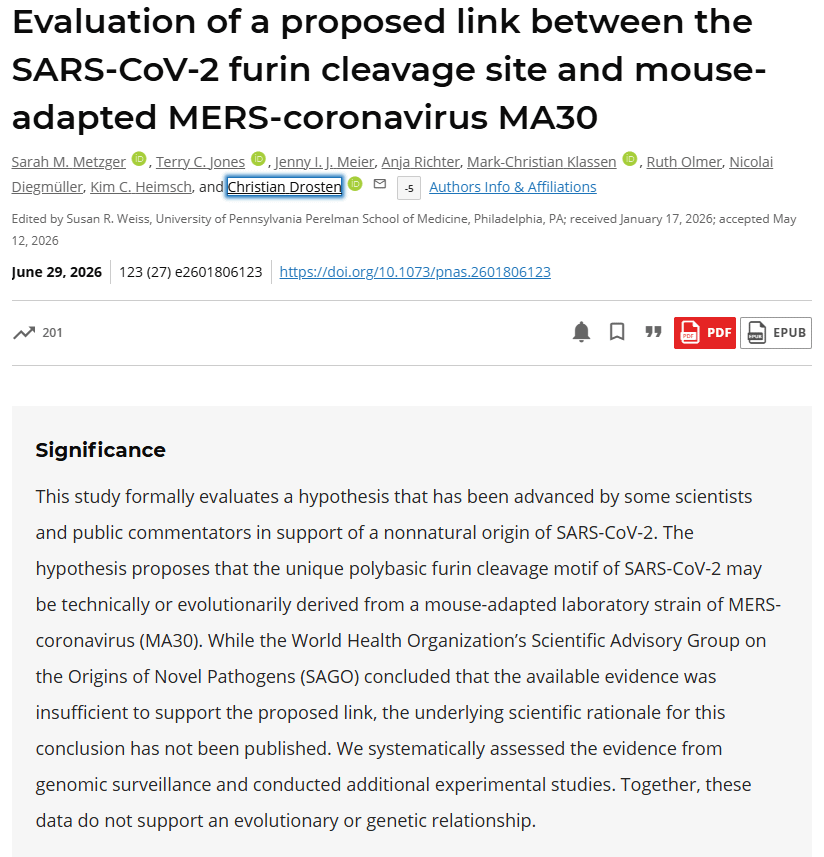
Drosten focused on Lisewski's theory of double spillover in Wuhan and Saudi Arabia. But Drosten ignored Baric’s 2019 citation (#41) of MERS-MA30. Many virologists, including Baric, claimed no one would add the leading (P) proline to the furin cleavage site (RRAR). Baric testified:
Why would anybody engineer that and do it that way, putting in an extra residue, which is a (P) proline, which puts kinks in proteins; it usually screws things up. And ultimately, that proline changed within one or two variants. So that didn’t make much sense to me. But if you were going to engineer it, I guess the question would be, you don’t need to put four amino acids in, it’s easier to put three amino acids in, in the frame. And also, you’d probably want to put one in that was efficient. The sequence in SARS2 is not a very efficient cleavage site.
When the student challenged the Master
Drosten was my hero early in the lab leak debate. He ruled out Shi Zhengli as a suspect because her Vero cells delete the furin cleavage site. He also pointed out that her reverse genetic system was more like a car stereo (e.g. WIV1) than a new car (e.g. SARS2). That left me with one suspect: Ralph Baric, who specialized in live-animal (in vivo) experiments.
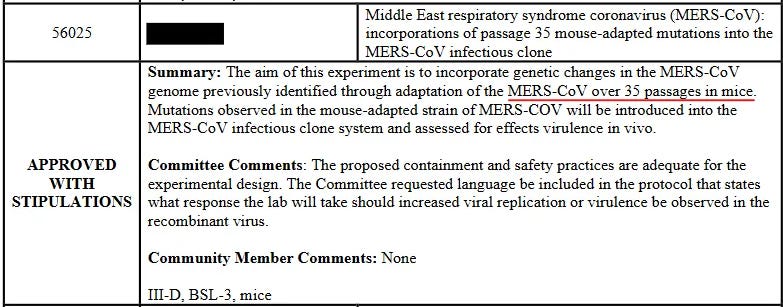
For Drosten's latest experiment, he relied on test tube (in vitro) experiments, whereas Baric favored in vivo mouse adaptation. MA30 literally means "mouse-adapted 30 times." Baric described this as "the classic virology approach to mouse-adapting a virus, using blind serial passage."
Notice Baric had 2019 UNC permission for 35 passages on MERS, with a furin cleavage site of PRSVR.
In 2017, Baric’s colleague, Stanley Perlman at the University of Iowa, noticed the MERS virus acquired a mutation at the S1/S2 furin cleavage site during serial mouse passage (MERS-MA30), changing the motif from PRSVR to PRRVR.
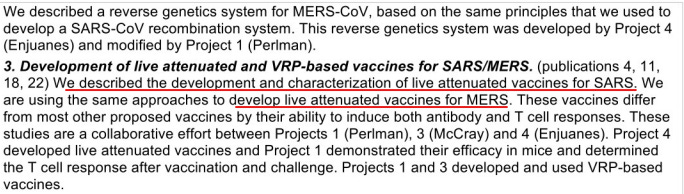
Why PRRVR? To develop live attenuated vaccines, just like SARS2.
Why RRAR and not RRVR, which is what Drosten tried to answer? In 2018, Baric researched ENaC with the RRAR/SVAS amino acid sequence.
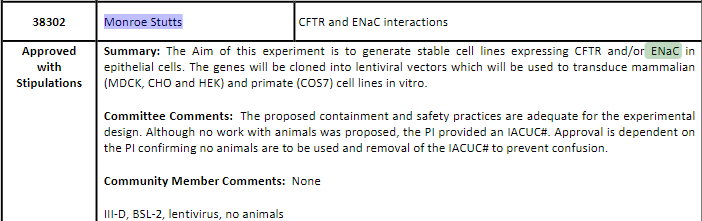
Why MERS? It was Baric’s select agent workaround. And as Jeff Sachs and I wrote:
This evidence is especially pertinent in view of the clear homology between amino acid sequences of SARS-CoV-2 and the furin cleavage site of ENaC (a lung and kidney epithelial protein studied at UNC), as shown below.
QTQTNS_____RSVASQ (RaTG13; Shi lab, WIV)
QTQTNSPRRARSVASQ (SARS2; RRARSVAS is identical with UNC research)
QTQTNS_____RSVASQ (Laos Banal-52; Eloit lab, Pasteur Institute)
Baric testified that the proline (the “P” in PRRAR) was unnecessary. Yet, as noted by Lisewski and presented to the World Health Organization, a similar furin cleavage site with a proline residue is present at the S1/S2 junction in the mouse-adapted MERS-MA30 variant, which Baric referenced in 2019. Because SARS-like viruses (sarbecoviruses) lack furin cleavage sites, Baric investigated MERS-like furin cleavage sites instead. He testified that “we were fundamentally interested in why didn’t sarbecoviruses have a furin cleavage site,” and that adding such a site was a “simple solution to the problem” of growing synthetic viruses in his lab.
I knew Drosten, like many virologists, read this blog. What I didn't expect was for him to critique my book:
The hypotheses about the lab origin are now flourishing, says Drosten, “and each time, the subtext is aimed at a specific research group.” The MA30-Furin rift is also a central element in various lab leak narratives, such as the book by blogger Jim Haslam, “Covid-19: Mystery Solved.” Drosten describes it as “a mixture of a completely fabricated tall tale, biological mix-ups and misunderstandings, and finger-pointing at certain individuals.”
From “just a blogger” to Citation #7 in PNAS. I’ll take it. But Drosten was cited twice in a controversial 2018 paper by Baric and Vincent Munster.
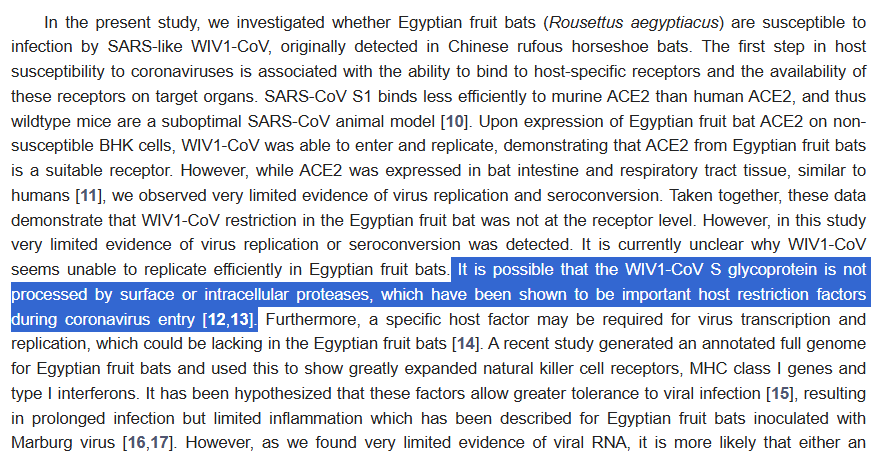
Basically, Baric and Munster referenced Drosten’s research on MERS-like (e.g. furin) and SARS-like (e.g. TMPRSS2) protease sites to create SARS2.

Baric and Munster were trying to get the bat virus inside the bat cell, or what Baric called “intracellular proteases.” Drosten et al called it “convertases.”
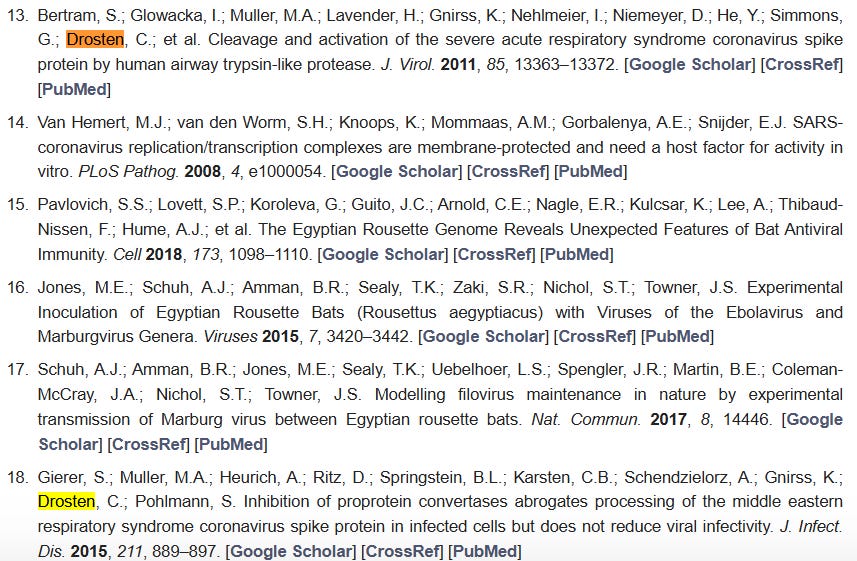
Drosten’s name is one of 100 in the back of my book because I asked him to provide a biological explanation for why this Old World virus, called SARS2, loves New World lab animals, but he didn’t respond. I linked to several peer-reviewed in vivo papers, mainly a German lab on Egyptian fruit bats, but he’s only produced in vitro evidence.

Drosten has been picked for round 2 of SAGO, along with Linfa Wang, so I look forward to continuing the in vivo debate, using peer-reviewed evidence.
In Vitro vs In Vivo
In vitro evidence (Latin for ‘in the glass’) is irrelevant to the origin of SARS2, because scientists can fudge answers. For example, an in vitro bat SARS2 paper reported “low expression” in Rousettus Aegyptiacus (Egyptian fruit bats), but a German paper reported “reservoir host” characteristics using in vivo research.
A visual of what happened: Shi shared bat samples with Baric, who created SARS2 in vitro, then Munster aerosolized the agent in Egyptian fruit bats (in vivo), and Dani Anderson tested the final product in Chinese bats.
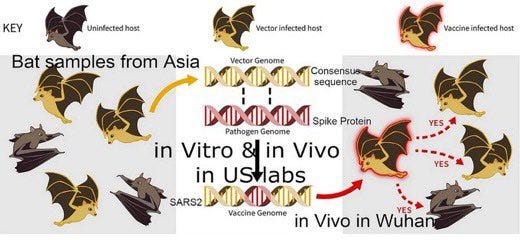
Fauci even defended himself by holding up Shi’s WIV BSL2 paper, which he wrote on as “only in vitro work,” but the new debate is Munster’s in vivo research.

D614G origins
Drosten’s PNAS paper also speculated on the origins of D614G, the first major mutation in SARS2 that led to the B.1 variant. Guess who researched the exact same mutation at the exact same spot? Ralph Baric! Back then, it was referred to as D613G in his SARS1 papers from 2006. Baric wrote in his 2011 vaccine paper:
Interestingly, the recombinant icSARS GD03-S virus described by Deming et al. developed a mutation (D613G) in a similar region of S during the process of virus stock generation, suggesting that some unique selective advantage for growth in culture may be encoded within this undefined region of Spike.
Drosten vs Wiesendanger
A court has forbidden Roland Wiesendanger from accusing Christian Drosten of lying regarding the origin of the coronavirus. Drosten was fully vindicated.
Most lab leakers dislike Drosten for various reasons, but I always admired him. After DARPA Defuse leaked, he identified UNC as the source of the furin cleavage site idea, and showed regret for signing the Lancet letter:
It also became known that there were plans to introduce furin cleavage sites, but this was to be done in an American laboratory, and the project was not funded,” Drosten said. “Many scientists, myself included, vouched for our colleagues in Wuhan at the time in The Lancet, but we weren’t informed about these projects. Had I known about them, I would at least have had questions before signing off on them.”
My Montana interview
Latest interview with a local Montana radio host DW Shumway
Drosten is actually trying to convince a court in Munich of his incompetence as an expert - for liability reasons: https://substack.com/@drbinesverbalesvitriol/note/p-204413360?r=31oy60
Prison ,Please .