
Why the Bat Vaccine Hypothesis Cannot Be Dismissed in Nature
SAGO scientists want to challenge our "widely circulating theory"

Scientists are debating our bat vaccine theory in Nature!
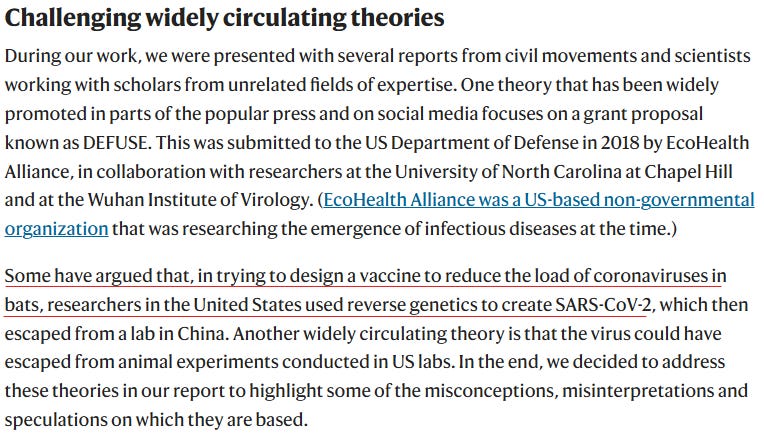
I respect the work of the WHO Scientific Advisory Group for the Origins of Novel Pathogens (SAGO). Their assignment was Mission Impossible: assess incomplete data amid geopolitical tension and intense public scrutiny. But it’s biologically impossible for anyone at the Wuhan Institute of Virology (WIV) or anything in the Wuhan wet market to have created COVID. To deny the evidence presented to SAGO is to deny Darwin himself.
Scientists sometimes view scientific truth as a popularity contest. But the truth-seeking individual will always be free from the collective to follow the evidence. For us truth seekers, this is good, since it supports a Wuhan-area lab leak but points to a US-area lab origin. For the scientific community, however, this becomes a hall of mirrors: reputations, funding, and credibility reflecting back on one another.
Nature is the most prestigious journal in science. We are grateful for the opportunity to publicly debate this serious subject, because none of us wants to relive the pandemic.
We remind SAGO that you have not identified a SARS-CoV-2 progenitor virus with 99% genome identity, nor have you identified an animal reservoir or intermediate host. We have proposed both: Ralph Baric’s HKU3-Smix and Vincent Munster’s Egyptian fruit bats.
Read SAGO’s entire article because it’s good, but it can be much better:
https://www.nature.com/articles/d41586-026-00530-y
Their Nature letter was SAGO’s second response to the letter Jeff Sachs and I submitted in May 2025, so this will be my third response to SAGO. At least we finally found a sparring partner in this debate, because hundreds of virologists have been challenged to disprove this bat vaccine theory. None have.

Wet Market vs Which Lab
The Huanan market may have amplified early transmission, but the question is origin, not amplification. SAGO’s framing is a binary choice between Lineage A and Lineage B. This overlooks a third issue: the best-known ancestral strain. The WA1 isolate was collected by an American traveler in Wuhan, who never visited the market, and returned to Seattle in early 2020.
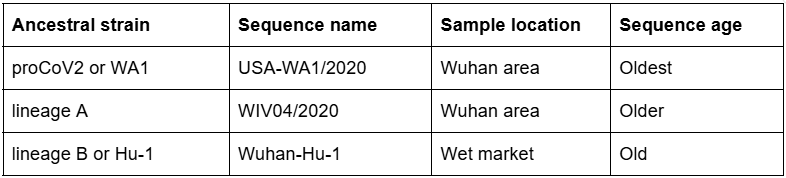
The WA1 isolate was then shared with several US labs. That international chain of custody matters when evaluating lab networks, material transfers, and pre-2020 experiments. WA1 demonstrates efficient transmission across five mammalian species commonly used in Rocky Mountain Lab (RML) research:
Egyptian fruit bat (FLI & email referenced below)
American deer mouse (CSU)
American white-tailed deer (KSU)
American mink (later variant via RML)
Syrian golden hamster (later variants via RML)
None of the above species are found in the Wuhan area, yet several appear in pre-pandemic research, at RML, on wildlife vaccination and transmission modeling.
If SARS-CoV-2 had originated in the Wuhan wet market, its Old World mammalian counterparts would have facilitated its spread. Yet the European CDC reported that no raccoon dog sequences were uploaded to genomic databases. By contrast, thousands of American deer and mink sequences have been uploaded.
Focusing on Wuhan biosafety compliance or US intelligence assessments misses the more technical question: how engineered genomes, animal passage models, and international material transfers intersected before the pandemic.
Regarding US intelligence, if Munster’s colleague Tony Schountz didn’t know, and Munster’s former Erasmus supervisor Marion Koopman didn’t know, it is unlikely the CIA knew what happened. The email below from Schountz to Munster identifies the SARS-CoV-2 reservoir host, using the WA1 isolate, which predates lineages A and B in the Wuhan wet market.


According to DARPA records and Vincent Racaniello, Schountz in Colorado raised Egyptian fruit bats for Munster’s PREEMPT project in Montana. In other words, the exact breeding colony of bats Munster used to aerosolize SARS-CoV-2 in 2019 is referenced in the above 2020 FOIA.
Outsiders vs Insiders
SAGO dismisses our submission as coming from “civil movements and scholars from unrelated fields.” But the evidence comes from DARPA fellows, virologists, and peer-reviewed analyses of genomic signatures. This ad hominem dismissal does not address the scientific evidence.
One of the controversial whistleblowers, vilified in the media, coauthored evidence of a lab leak published in Nature. Syrian golden hamsters were used as a transmission model in NIH-funded research on self-spreading bat vaccines.

DEFUSE was discovered in a classified folder by Major Joseph Murphy, a DARPA fellow with direct expertise in biological threats. His 2021 letter to the Department of Defense explicitly described SARS-CoV-2 as an “American-created recombinant bat vaccine.” This was years before we learned that COVID infects and transmits in American lab bats.
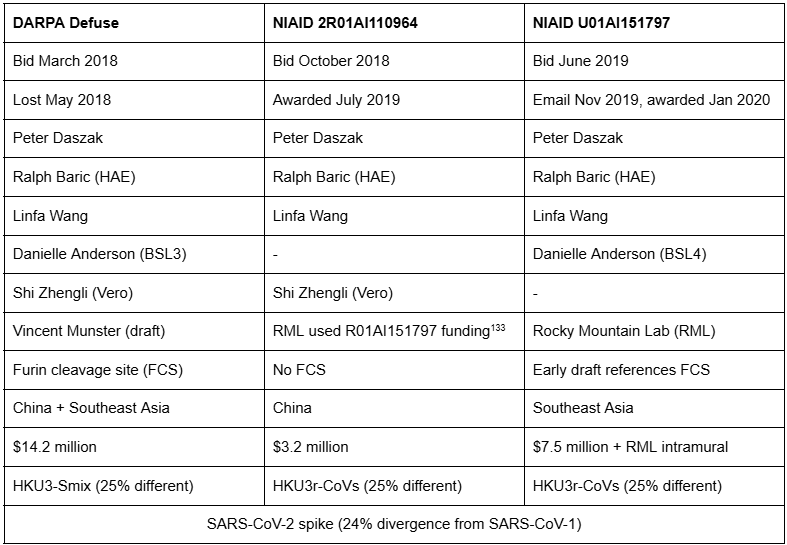
Murphy added, “As is known, Dr. Fauci with NIAID did not reject the proposal.” This was years before we learned that Peter Daszak and Ralph Baric split the DEFUSE bid. We commend the committee for considering the new evidence that NIH funded DEFUSE, as newly released Daszak emails, marked not to be shared with Congress, confirm the table below.
I’ll also remind SAGO that it took a Group of 36 outsiders — many of them aerosol specialists, HVAC designers, and mechanical engineers — to push the WHO to acknowledge airborne transmission. Those of us trained in fluid dynamics recognized the signal early because we understand how particles move indoors. Since aerosolization is central to transmission, we can identify the (lab) animals that created COVID before 2020.
SAGO’s Protein-Only Claim is Incorrect
SAGO writes in Nature:
The DEFUSE grant proposal mentions a vaccine technology based on recombinant chimeric live coronavirus vectors, which contain parts of different Sarbecovirus genomes. It also mentions recombinant expression of synthetic genes encoding chimeric spike proteins. These are proteins (not viruses) that consist of parts of the spike protein of a bat coronavirus, SHC014-CoV, parts of another previously known bat coronavirus, HKU3, as well as parts of SARS-CoV-1.
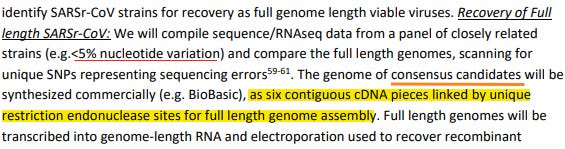
An early DEFUSE draft explicitly states that Baric would “synthetically reconstruct a panel of high-risk full-length SARS-CoV strains.”
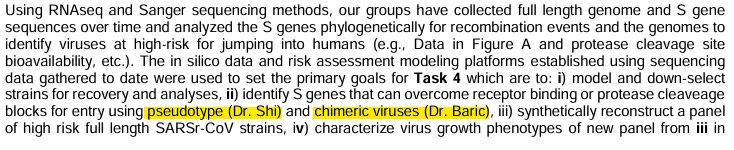
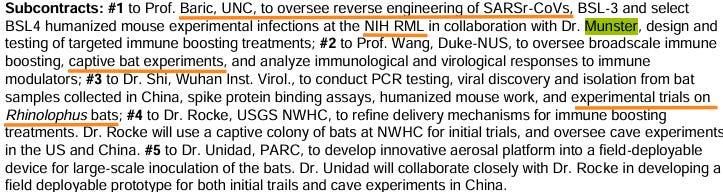
Baric proposed to “provide” his chimeras, such as HKU3-Smix, to Linfa Wang and Zhengli Shi for experimentation in Chinese horseshoe bats. This describes a live virus being tested on live bats.

Ironically, because DEFUSE was not funded as is, the safe raccoonpoxvirus vaccine vector was not used, so RML was used instead. But virologist Vincent Racaniello, in a podcast, picked up on the dangerous aspect of DEFUSE: immune boosting of bats.
SAGO claims DEFUSE only proposed “proteins (not viruses)” for bat vaccination by writing in Nature:
In their grant application — which was never actually funded — they proposed using only recombinant proteins (or subunit antigens) to vaccinate bats. These cannot replicate or spread.
This is demonstrably false, since the “bats will be…inoculated with WIV1.”
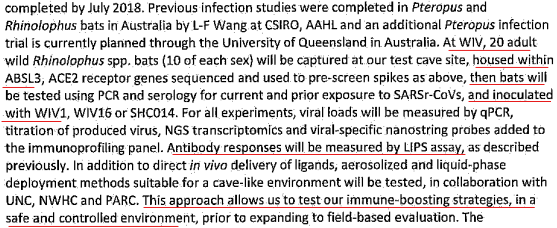
Virologist Stuart Neil noted the WIV1 virus was a “proof of principle.”
That WIV1 research from DEFUSE continued at RML — and in Egyptian fruit bats.
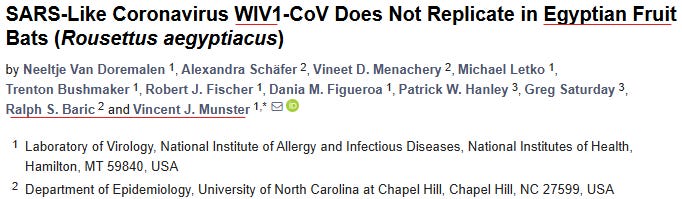
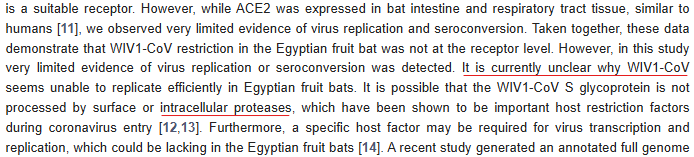
Baric and Munster, collaborating since 2016, wanted to add “intracellular proteases” or a furin cleavage site after failing to achieve infection. SARS-CoV-2 remains the only group 2B coronavirus with a furin cleavage site (PRRARSV).
Also note the MERS-like furin cleavage site below. SAGO even received a MERS-MA30 presentation (PRRVRSV), which Baric referenced in 2019. Because SARS-like viruses lack furin cleavage sites, Baric researched MERS-like viruses.
In 2018, Baric and Munster wanted to test their final product in Chinese horseshoe bats, available only at the WIV.
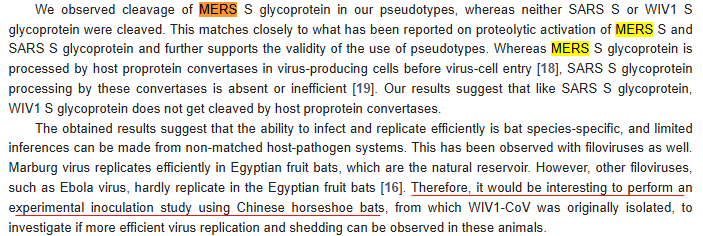
We just answered the one question no one else can: why Wuhan?
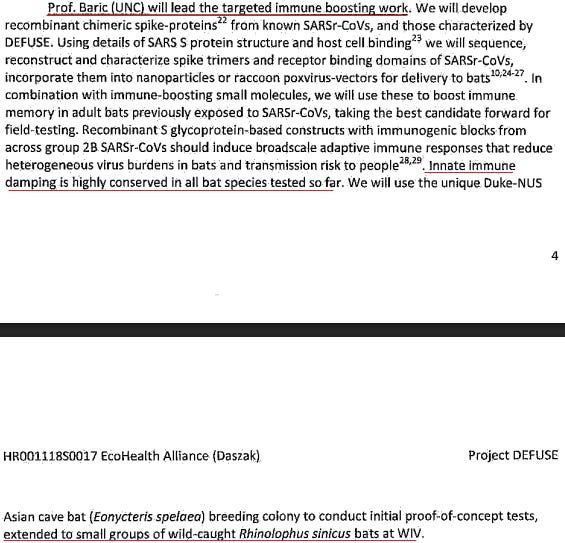
Those same Egyptian fruit bats (Rousettus aegyptiacus) are a reservoir host for SARS-CoV-2, but “these bats are not present in China.”

The SHC014 Misdirection
SAGO dwells on the SHC014 bat sample, claiming it was only used for “binding assays” with proteins. Yet Baric himself wrote: “The use of SHC014-MA15 as a live, attenuated vaccine showed potential cross-protection against challenge with SARS-CoV.” Baric was using Shi’s bat samples to create live attenuated vaccines, not “mere proteins.”
After publishing his controversial 2015 paper describing a live chimera derived from Shi’s sequence, Baric told STAT News he was seeking SARS-like viruses that differed by less than 25%. RaTG13’s spike is 24.6% different. Emails recently released by DRASTIC show Shi sharing unpublished group 2b coronaviruses with Baric.

SARS1 vs SARS2 Clades
SAGO writes in Nature:
The SHC014-CoV sequence was provided by a researcher at the Wuhan Institute of Virology, and a research team at the University of North Carolina at Chapel Hill conducted binding assays to determine whether SHC014-CoV is capable of infecting human cells with ACE2 receptors. But the genome elements making up the recombinant chimeric live coronavirus do not belong to the clade to which SARS-CoV-2 belongs (a clade is a group of genetically similar viruses). Indeed, the terms recombinant and chimeric have different meanings depending on whether they are being used for live viruses or mere proteins.
The DEFUSE proposal describes recombinant chimeric sarbecoviruses and spike-swapping strategies using HKU3, SHC014, and SARS-related backbones. The term “chimera” in this context refers to replication-competent viruses assembled from genomic elements of different clades—not just proteins.

SAGO emphasizes that SHC014 (clade 1) and HKU3 (clade 2) are not part of the SARS-CoV-2 (clade 1B). That is correct, since Baric has created a new clade 1B, which is a backbone from clade 2 and a spike from clade 1. Recombination occurs both in nature and in Baric’s lab. His vaccine research crosses clade boundaries by design.
In his testimony, Baric described HKU3-Smix as a clade 2 backbone with a clade 1A spike. The spike domains (NTD, RBD, S2) were modular. That modularity is how he achieved a 25% deviation from SARS-CoV-1—exactly where SARS-CoV-2’s spike sits at 24.7%.
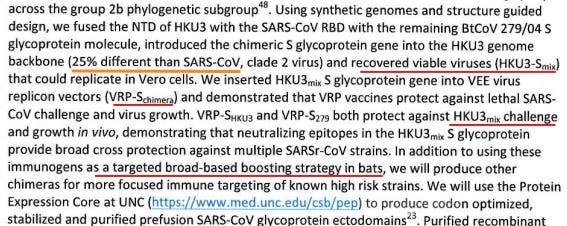
The Progenitor Question
The issue is not whether SARS-CoV-2 is identical to SHC014 or HKU3. The issue is whether HKU3-Smix is the progenitor of SARS-CoV-2.

Baric’s HKU3-Smix chimera falls between SHC014 (~12%) and HKU3 (~30%) on the group 2b coronavirus phylogenetic tree. Baric admitted, “It turns out SARS-CoV-2 had 22% variation, so we were within the range.”

Baric was referencing EcoHealth notes, shown above, which were obtained only through a USGS FOIA request. Note that the entire SARS-CoV-2 genome differs by ~20% at the nucleotide level, whereas the spike differs by ~25%. In testimony, Baric apparently split the difference, claiming 22%.
Baric admitted that HK3 = HKU3 and that 293 was a typo. It was 279, and he patented the HKU3-Smix chimera in 2018.

Baric would “provide viral vectors,” such as HKU3-Smix, to Linfa Wang.
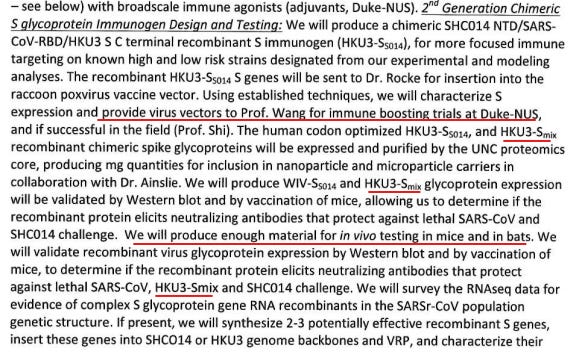
Anonymous Expert Confirmation

After Murphy leaked DEFUSE, an anonymous genetics expert working with the WHO told the Telegraph that if SARS-CoV-2 had been derived from a “consensus” sequence, it would explain why no close match has been found in nature.
“They would take various sequences from similar coronaviruses and create a new sequence that is essentially the average of them... They would then synthesise the viral genome from the computer sequence, thus creating a virus genome that did not exist in nature but looks natural as it is the average of natural viruses... If SARS-CoV-2 comes from an artificial consensus sequence composed of genomes with more than 95% similarity to each other... I would predict that we will never find a really good match in nature and just a bunch of close matches across parts of the sequence, which so far is what we are seeing.”
There is a reason SAGO has not found a natural sequence within 3% of SARS-CoV-2. That is exactly what Baric proposed to create. HKU3-Smix is closer to SARS-CoV-2 than either RaTG13 or Laos Banal-52.
LAV vs VSV
Baric’s platforms were portable, transferable, and deployable worldwide via standard “cold-chain” shipment. Early DEFUSE drafts proposed that Baric and Munster created bat vaccines and forwarded them to Linfa Wang.
SAGO conflates Baric’s LAV research with Munster’s VSV research by writing:
Other grant proposals submitted to the US National Institutes of Health and implicated in theories about a lab origin for SARS-CoV-2 involved vaccinating bats with a vaccine consisting of modified vaccinia Ankara and vesicular stomatitis virus [VSV] vectors. This vaccine technology uses safe, well-characterized, non-replicating vaccine vectors that present only a single protein of the pathogen in question to stimulate an immune response. Lastly, animal experiments involving SARS-CoV-2 were conducted in various species and countries only after the virus had been discovered in 2020.
In 2019, Baric’s LAVs were shipped to RML for “animal experiments.” Those unknown 2019 animal experiments were replicated in 2020, during the pandemic.
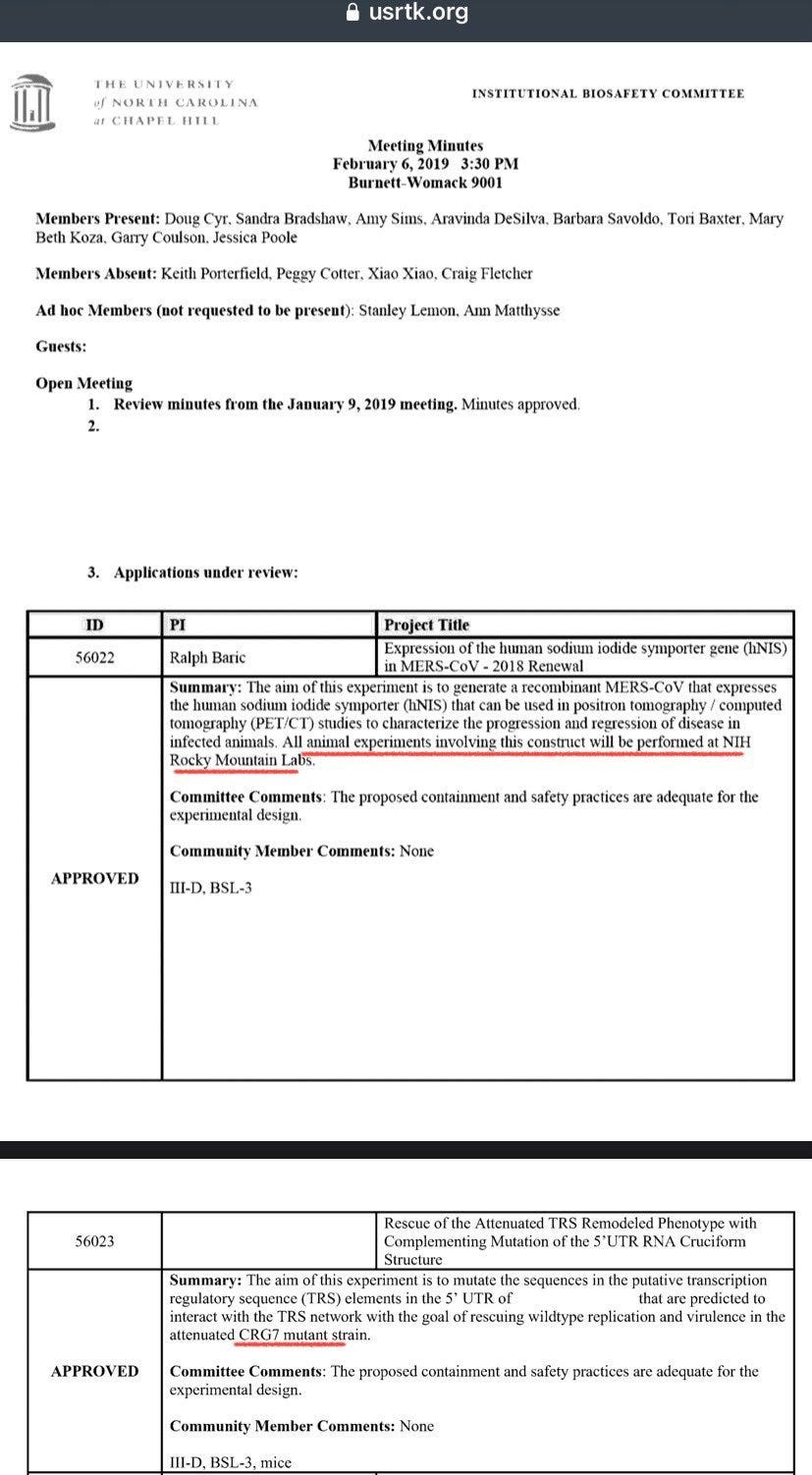
After Baric lost DEFUSE, he published a 2018 Nature paper describing the development of live-attenuated vaccines using TRS-mutant sequences (CRG7 or UGGUCGC). Baric’s LAV paper, citing “national security” and the Mojiang “mineshaft,” states that these viruses are designed for “reservoir species, such as bats.”
This construct was shipped to RML in early 2019. The WA1 ancestral strain shows that it was then forwarded to Wuhan, where it accidentally leaked from the WIV. We humans were merely an intermediary species in their bat vaccine experiment.
Conclusion
SAGO focuses on in vitro genomic evidence while ignoring dozens of peer-reviewed in vivo transmission studies. SARS-CoV-2 is Baric’s genome (formerly called HKU3-Smix) and exploits Munster’s pre-pandemic transmission models (hamsters, mink, deer, deer mice). Tellingly, Baric’s proxy species, Mexican free-tailed bats, seroconvert but do not transmit, while Munster’s Egyptian fruit bats both carry and transmit SARS-CoV-2.
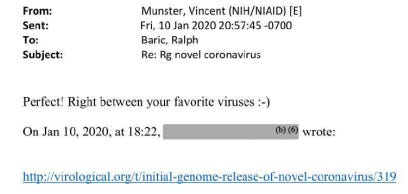
On the same day Linfa Wang resigned, Munster emailed Baric, saying, “Perfect! Right between your favorite viruses :-)” Those were SHC014 and HKU3. What was called HKU3-Smix was funded as HKU3r-CoVs in 2019 and renamed SARS-CoV-2 in 2020. All three names appear in an early DEFUSE draft.

Dismissing this bat vaccine hypothesis as “scientifically implausible” requires more than invoking clade distinctions or noting that DEFUSE was unfunded. It requires demonstrating that reverse genetics combined with in vivo passage could not produce a virus with SARS-CoV-2’s genomic structure. That demonstration has not been made.